

Table of Contents
Contact Us
Recent Posts
Follow Us
Introduction
With the rapid growth of cold chain logistics, many businesses are looking to convert existing warehouses, factories, garages, or other suitable buildings into cold storage warehouses.
Compared with constructing a new facility, warehouse conversion can make better use of existing buildings, shorten the construction period, and reduce certain upfront costs.
However, converting a regular warehouse into a cold storage warehouse is not simply a matter of installing insulation panels and refrigeration equipment. The existing building must also be evaluated for structural capacity, insulation, fire protection, electrical capacity, floor conditions, and material flow.
In this guide, we will explain what cold storage is, the differences between building a new cold storage facility and converting an existing warehouse, the key factors to consider, and the major steps involved in the conversion process.
What Is Cold Storage?
Cold storage refers to the controlled storage of temperature-sensitive products in a refrigerated environment. A cold storage warehouse is specifically designed to maintain the required temperature and environmental conditions throughout storage and handling.
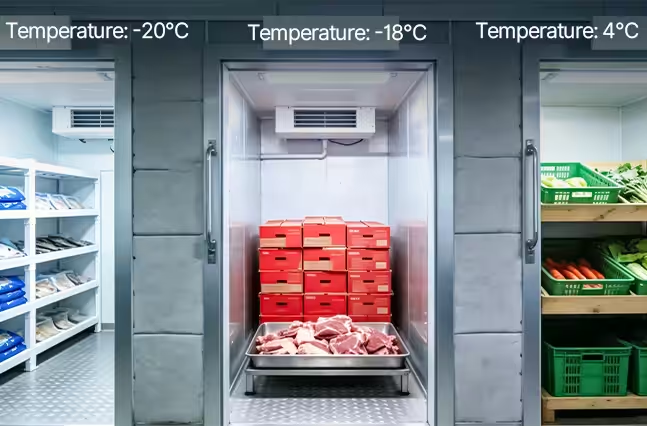
Depending on the products and operating requirements, cold storage facilities can include different temperature zones, such as:
- Chilled storage: For products that require temperatures above freezing.
- Frozen storage: For products that need to remain below 0°C.
- Deep-freeze storage: For products requiring significantly lower temperatures.
- Specialized temperature-controlled storage: For pharmaceuticals, chemicals, and other temperature-sensitive products.
Cold storage warehouses are commonly used for:
- Food and beverage products
- Frozen foods
- Meat and seafood
- Dairy products
- Pharmaceuticals
- Chemicals
- Other temperature-sensitive goods
Unlike conventional warehouses, a cold storage warehouse requires an integrated system of refrigeration, insulation, temperature monitoring, and environmental control. The warehouse design must also consider factors such as:
- Required storage temperature
- Product characteristics
- Storage capacity
- Inventory turnover
- Loading and unloading frequency
- Storage duration
- Material handling requirements
Therefore, converting an existing building into a cold storage warehouse requires a comprehensive evaluation of both the building and the future operating requirements before construction begins.
New Cold Storage Warehouse vs. Converting an Existing Warehouse
When planning a cold storage warehouse, businesses generally have two options: construct a new facility or convert an existing warehouse, factory, or other suitable building.
The two approaches differ significantly in terms of initial investment, construction time, long-term operating costs, and suitability for different business needs.
| Factor | New Cold Storage Warehouse | Converting an Existing Warehouse |
|---|---|---|
|
Initial investment |
Generally lower because the existing building structure can be reused |
Generally higher, with major costs from land, foundations, structural construction, and supporting infrastructure |
|
Construction time |
Usually longer due to planning, approvals, construction, equipment installation, and commissioning |
Usually shorter because major structural construction can be avoided |
|
Civil construction costs |
Can account for a significant portion of the total project investment |
Can be significantly reduced depending on the existing building condition |
|
Operating costs |
New insulation, refrigeration, and supporting systems can provide better energy efficiency |
Existing structural limitations may result in higher energy consumption and maintenance requirements |
|
Design flexibility |
High; the facility can be designed specifically for cold storage requirements |
More limited by the existing building structure, height, layout, and load capacity |
|
Best suited for |
Long-term strategic cold chain facilities, major expansions, and high-standard logistics hubs |
Businesses with suitable existing buildings, limited budgets, or urgent deployment requirements |
Cost Considerations
Building a new cold storage warehouse generally requires a higher upfront investment. Major costs include land acquisition, foundation work, structural construction, walls, roofing, and supporting infrastructure.
For a new facility, civil construction can represent a significant portion of the overall project cost, particularly when the site requires extensive foundation and structural work.
By contrast, converting an existing warehouse can eliminate much of the civil construction cost. The main investment is usually concentrated on insulation upgrades, refrigeration equipment, electrical systems, fire protection, and other modifications required for cold storage.
The actual cost difference depends on the existing building structure, conversion scope, required storage temperature, warehouse size, and local construction conditions.
Construction Time and Time to Operation
A new cold storage facility normally requires a longer project cycle because the process may include site preparation, approvals, civil construction, equipment installation, testing, and commissioning.
As a general reference, a new project may take 3–6 months, depending on project scale and local requirements.
Converting an existing warehouse can shorten the construction period because the main building structure is already available:
- Small-scale conversion: approximately 1–2 months
- Large-scale conversion: approximately 3–4 months
The actual schedule depends on the building condition, conversion scope, equipment requirements, and approval procedures.
Long-Term Operating and Maintenance Costs
A newly built cold storage warehouse can be designed around modern insulation, refrigeration, electrical, and control systems from the beginning.
This can help improve energy efficiency and reduce maintenance requirements over the long term.
A converted facility may have higher operating and maintenance costs because the original building can impose limitations on insulation performance, equipment compatibility, structural conditions, and supporting infrastructure.
For this reason, the initial cost advantage of conversion should always be evaluated together with expected energy consumption, maintenance requirements, and the remaining service life of the existing building.
Which Option Is Right for Your Business?
A new cold storage warehouse may be more suitable when:
- No suitable existing building is available.
- The existing structure cannot meet cold storage requirements.
- Major expansion is planned.
- A high-standard cold chain logistics hub is required.
- The business has long-term strategic plans for the facility.
Converting an existing warehouse may be more suitable when:
- A suitable and compliant building is already available.
- The existing structure can support the required modifications.
- The project has a limited budget.
- The business needs to start operations quickly.
- Short-term capacity growth is expected, while long-term expansion requirements remain uncertain.
Key Considerations When Converting a Warehouse into Cold Storage
Converting a regular warehouse into a cold storage warehouse involves much more than adding insulation and refrigeration equipment.
The existing building must be carefully evaluated for structural safety, thermal insulation, fire protection, electrical capacity, and internal logistics before the conversion begins.
Floor Insulation and Frost Heave Protection
Most conventional warehouses are not designed with floor insulation or frost heave protection for low-temperature storage.
For large low-temperature cold storage facilities operating at around -15°C to -25°C, the floor should be specially designed to prevent frost heave and protect the building structure.
Common professional solutions include:
- Ventilated floor systems: Cement ventilation pipes are embedded beneath the floor to reduce ground temperature through natural airflow.
- Glycol circulation systems: Anti-freeze liquid, such as glycol maintained at around -5°C, is circulated beneath the floor to control ground temperature.
- Electric heating systems: Electric heating elements are installed beneath the floor to prevent excessive freezing and frost heave.
For smaller low-temperature cold rooms, a thickened insulation layer combined with a 300 mm or deeper crushed-stone layer may help reduce frost heave risks, depending on the site conditions.
However, more intensive frost protection may be required when the cold storage area exceeds 500 m² or the operating temperature is below -20°C.
The loading dock area also requires special attention. In some conversion projects, the dock floor may need to be lowered by approximately 300 mm and specially treated to reduce the risk of cracking caused by frost heave.
Roof and Structural Load Capacity
Converting a regular warehouse into a cold storage facility adds insulation materials, refrigeration equipment, suspended components, and other loads to the existing structure.
Therefore, the load-bearing capacity of the existing roof structure, steel frame, and purlins must be checked before construction.
This is particularly important in regions with heavy snow or strong winds, where additional snow loads and wind loads can significantly affect structural safety.
There is no universal maximum height for a converted cold storage warehouse. The practical storage height depends on the results of the existing structure’s load-bearing assessment.
If the original structure does not provide sufficient capacity, reinforcement may be required, or the usable internal height may need to be reduced.
A qualified structural engineer should be engaged to inspect and verify the existing structure before the conversion begins.
Fire Protection System
Standard wet-pipe sprinkler systems used in conventional warehouses may not be directly suitable for low-temperature cold storage areas.
When the ambient temperature falls below freezing, water inside the sprinkler piping can freeze and expand, potentially causing pipe damage or system failure.
Simply adding insulation around sprinkler heads does not necessarily solve the freezing problem.
Depending on the applicable local fire codes and operating temperature, the fire protection system may need to be redesigned using solutions such as:
- Dry-pipe sprinkler systems
- Pre-action sprinkler systems
- Additional fire compartmentation
- Other code-compliant fire protection measures
The final fire protection design should always be determined according to local regulations, warehouse conditions, stored goods, and the specific cold storage temperature.
Electrical Capacity
Refrigeration equipment can significantly increase the electrical load of a cold storage facility.
Existing warehouse electrical capacity should therefore be assessed before installing compressors, condensers, evaporators, control systems, lighting, and other equipment.
Particular attention should be paid to equipment starting currents, which can be significantly higher than normal operating currents.
If the existing electrical capacity is insufficient, the project may require:
- Transformer capacity upgrades
- Dedicated power circuits
- New electrical cables
- Distribution system upgrades
- Additional electrical protection equipment
The electrical system should be sized according to the actual refrigeration load and the total operating load of the converted facility.
Ceiling Height and Material Flow
The existing warehouse’s clear height directly affects the usable capacity and layout of the converted cold storage warehouse.
Sufficient clearance should be maintained between the cold storage ceiling and the original building roof to provide space for ventilation, equipment installation, inspection, and future maintenance.
A clearance of approximately 300 mm or more may be considered as a reference, but the final requirement should be determined by the insulation system, structural conditions, equipment configuration, and local design standards.
Material flow is another important consideration. Cold storage operations generally require fast loading and unloading because unnecessary door opening and material movement can increase energy consumption.
The warehouse layout should therefore consider:
- Dock and loading positions
- Receiving and shipping areas
- Storage locations
- Forklift or automated equipment routes
- Door positions
- Product movement distance
A shorter and more efficient material flow can help improve operational efficiency while reducing unnecessary movement inside the temperature-controlled environment.
How to Build a Cold Storage Warehouse from an Existing Building
Knowing how to build a cold storage warehouse starts with a detailed assessment of the existing building rather than immediately installing refrigeration equipment.
The conversion process should cover site evaluation, refrigeration, insulation, control systems, testing, and commissioning to ensure the finished facility meets both operational and safety requirements.
Step 1: Design Planning and Site Assessment
Before converting an existing warehouse, a professional engineering team should inspect the building and evaluate its suitability for cold storage.
The design process should determine:
- Cold storage type: chilled, frozen, or deep-freeze storage
- Required storage temperature
- Warehouse size and layout
- Product characteristics
- Storage capacity and turnover
- Refrigeration system requirements
- Insulation specifications
- Cold storage door configuration
- Fire protection requirements
- Material handling and logistics flow
The design team should also evaluate the existing building’s structure, floor conditions, electrical capacity, ceiling height, and available installation space.
HUAYIDE has extensive experience in cold storage projects and provides professional engineering and design support. After evaluating the customer’s actual requirements and site conditions, the HUAYIDE team can develop a detailed warehouse layout and provide free 3D layout and simulation animation services to visualize the proposed solution before implementation.
Step 2: Install the Refrigeration System
The refrigeration system is the core of a cold storage warehouse. Key components typically include compressors, evaporators, condensers, expansion devices, and control equipment.
Modern refrigeration solutions may use variable-frequency compressors and environmentally friendly refrigerants to adjust cooling capacity according to the actual warehouse load.
When selecting refrigeration equipment, businesses should consider more than the nominal horsepower. Key parameters include:
- Refrigeration capacity
- Energy efficiency
- Evaporation temperature
- Refrigerant type
- Operating temperature
- Product heat load
- Ambient conditions
For example, a 500 m³ freezer operating at -18°C with approximately 10% daily inventory turnover may require a refrigeration capacity in the range of 50–70 kW, depending on the actual operating conditions.
The final refrigeration capacity should be calculated by a qualified refrigeration engineer based on factors such as incoming product temperature, door-opening frequency, insulation performance, ambient temperature, and required pull-down time.
Step 3: Build the Insulated Enclosure
The insulated enclosure is essential for maintaining stable temperatures and minimizing refrigeration energy consumption.
Insulation should generally be installed across the:
- Walls
- Ceiling
- Floor
Common solutions include polyurethane cold storage panels and in-situ polyurethane spray insulation.
The required insulation thickness should be determined by a professional engineer based on local climate conditions, warehouse size, target temperature, product heat load, and energy-efficiency requirements.
Particular attention should be paid to panel joints and potential thermal bridges. Gaps should be properly sealed with suitable foam or sealant to prevent cold air leakage and moisture infiltration.
The floor should also include an appropriate moisture barrier and vapor barrier to prevent moisture from entering the insulation layer and reducing its thermal performance.
Step 4: Install Temperature Monitoring and Control Systems
Modern cold storage warehouse management increasingly relies on intelligent monitoring and control technologies.
An automated temperature control system can coordinate sensors, controllers, and operating equipment to maintain the warehouse within the required temperature range.
The system can also include:
- Real-time temperature monitoring
- Temperature deviation alarms
- Equipment status monitoring
- Remote monitoring
- Mobile app notifications
When abnormal temperature conditions occur, the system can automatically alert warehouse personnel, helping operators respond quickly and reduce the risk of product loss.
Step 5: Testing, Commissioning, and Acceptance
After the conversion work is completed, the entire cold storage warehouse should undergo comprehensive testing and commissioning.
Key checks should include:
- Refrigeration equipment operation
- Temperature stability
- Insulation and sealing performance
- Control system operation
- Electrical system safety
- Door and material handling operation
- Fire protection compliance
Once the system has been confirmed to operate correctly, warehouse personnel should be trained in proper equipment operation and daily procedures.
A preventive maintenance program should also be established. Routine tasks may include cleaning evaporator coils, managing frost buildup, inspecting refrigeration equipment, checking door seals, and maintaining appropriate hygiene and sanitation procedures.
How to Improve Cold Storage Warehouse Management
Building a cold storage warehouse is only the first step. Efficient cold storage warehouse management is equally important for controlling operating costs, maintaining product quality, and maximizing available storage capacity.
Because refrigerated facilities consume significant energy and require controlled operating conditions, daily warehouse management should focus on several key areas:
- Temperature management: Continuously monitor storage temperature and respond quickly to temperature deviations.
- Inventory management: Maintain accurate inventory records and apply appropriate FIFO or FEFO strategies where required.
- Door management: Minimize unnecessary door openings to reduce cold air loss and refrigeration loads.
- Space utilization: Make full use of available vertical and horizontal storage space.
- Material handling: Optimize product movement between receiving, storage, picking, and shipping areas.
- Energy management: Monitor refrigeration equipment and identify opportunities to reduce unnecessary energy consumption.
- Equipment maintenance: Regularly inspect refrigeration, electrical, control, and material-handling equipment.
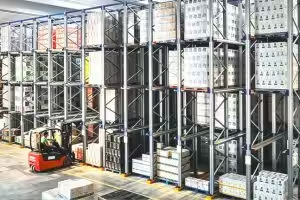
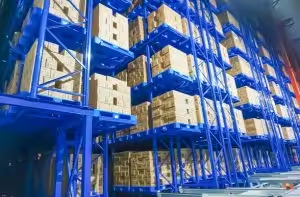
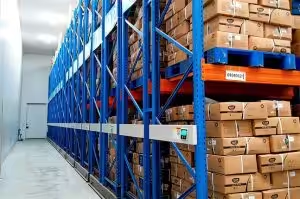
Automated Dense Storage Systems for Cold Storage Warehouses
Storage density is particularly important in a cold storage warehouse because refrigerated space is expensive to construct, cool, and maintain.
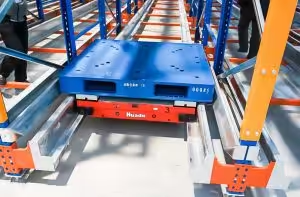
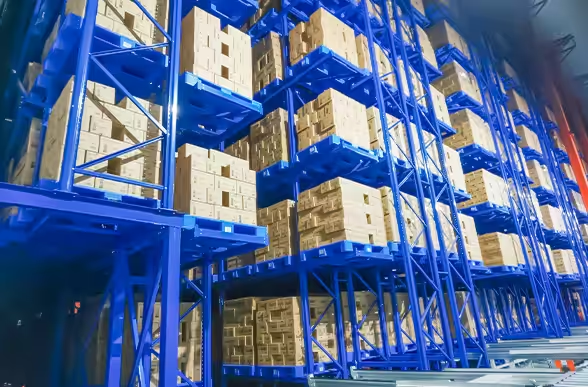
Automated dense storage systems can make better use of available warehouse space while reducing forklift travel and limiting the time operators need to work in low-temperature environments.
Depending on storage capacity, throughput, pallet characteristics, SKU requirements, and warehouse layout, businesses can consider solutions such as:
- Pallet Shuttle Systems for high-density pallet storage
- Four-Way Pallet Shuttle Systems for flexible multi-depth storage
- AS/RS Stacker Crane Systems for high-density automated pallet storage
- Shuttle + Stacker Crane Systems for combining high density with automated handling
These technologies can help increase storage capacity, improve material handling efficiency, and reduce unnecessary personnel exposure to cold environments.
For a more detailed comparison of automated dense storage technologies and their applications in refrigerated facilities, see our guide:
Automated Dense Storage Systems in Cold Storage Warehousing
This article explores different racking systems used in cold storage warehousing and explains why automated dense storage solutions are becoming the preferred choice for modern refrigerated warehouses.
Should You Build a New Cold Storage Warehouse or Convert an Existing One?
Choosing between a new cold storage warehouse and an existing warehouse conversion depends on the building condition, investment budget, project timeline, storage requirements, and long-term business plans.
Before making a decision, businesses should evaluate the following factors:
| Consideration | Convert an Existing Warehouse | Build a New Cold Storage Warehouse |
|---|---|---|
|
Existing site |
A suitable warehouse or factory is already available |
No suitable existing building is available |
|
Structural condition |
The existing structure must meet load and safety requirements |
The structure can be designed specifically for cold storage |
|
Initial investment |
Can reduce certain construction and civil engineering costs |
Generally requires higher upfront investment |
|
Project timeline |
Usually faster because the main building already exists |
Usually requires a longer construction and approval process |
|
Layout flexibility |
Limited by the existing building |
Layout can be designed around operational requirements |
|
Future expansion |
Depends on available site and existing structure |
Can be planned into the initial design |
|
Best suited for |
Fast deployment, suitable existing facilities, and controlled investment |
Long-term expansion and large-scale cold chain facilities |
If the existing warehouse has sufficient structural capacity, suitable clear height, and adequate space for insulation, refrigeration, fire protection, and material handling systems, conversion can be an efficient option.
For businesses with long-term expansion plans, complex operational requirements, or the need for a purpose-built high-standard cold chain facility, constructing a new warehouse may provide greater design flexibility.
Ultimately, the right approach should be determined through a professional site assessment and a comparison of both initial investment and long-term operating requirements.
A well-designed cold storage warehouse should not only maintain the required temperature but also provide efficient storage, reliable material handling, safe operations, and room for future development.
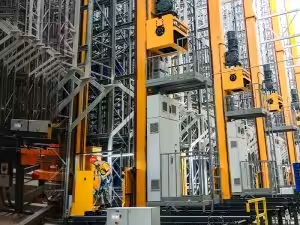
Explore HUAYIDE’s -25°C ice cream ASRS project in Indonesia, showcasing automated high-density storage for cold chain warehousing.
Conclusion
Converting a regular warehouse into a cold storage warehouse can be an efficient way to expand temperature-controlled storage capacity without starting a completely new construction project.
However, the success of a conversion depends on more than refrigeration equipment. Structural capacity, floor insulation, frost protection, fire safety, electrical capacity, insulation performance, material flow, and cold storage warehouse management all need to be considered during the planning stage.
For businesses handling large volumes of palletized goods, combining cold storage infrastructure with automated dense storage can further improve space utilization and operational efficiency.
HUAYIDE provides integrated warehouse automation and storage solutions for cold chain applications, from storage system design and equipment manufacturing to project implementation and commissioning. By combining professional engineering with automated storage technologies, HUAYIDE helps businesses build efficient and high-density cold storage facilities tailored to their operational requirements.
If you are planning to build or convert a cold storage warehouse, contact HUAYIDE to discuss your storage requirements and explore a suitable solution for your facility.
Frequently Asked Questions
1. What is cold storage?
Cold storage is the controlled storage of temperature-sensitive products in a refrigerated environment. It helps maintain the required temperature and environmental conditions for products such as food, beverages, pharmaceuticals, and chemicals.
2. What is a cold storage warehouse?
A cold storage warehouse is a temperature-controlled facility designed to store products that require chilled, frozen, or deep-freeze conditions.
Unlike a conventional warehouse, it requires integrated insulation, refrigeration, temperature monitoring, and environmental control systems.
3. Can a regular warehouse be converted into a cold storage warehouse?
Yes. An existing warehouse, factory, or other suitable building can be converted into a cold storage warehouse if its structure and supporting infrastructure meet the required conditions.
Before conversion, the building should be evaluated for structural capacity, floor conditions, insulation, electrical capacity, fire protection, ceiling height, and material flow.
4. How to build a cold storage warehouse from an existing building?
The conversion process generally includes:
- Site assessment and design planning
- Refrigeration system installation
- Insulated enclosure construction
- Temperature monitoring and control system installation
- Testing, commissioning, and acceptance
The exact process depends on the building condition, required temperature, storage capacity, products, and local regulations.
5. How can I improve cold storage warehouse management?
Effective cold storage warehouse management should focus on temperature control, inventory accuracy, door management, space utilization, material handling, energy consumption, and equipment maintenance.
For high-volume pallet storage, automated dense storage systems can also improve storage density and reduce unnecessary material movement.
6. Is automated storage suitable for cold storage warehouses?
Yes. Automated storage can be particularly suitable for cold storage applications where space utilization, storage density, and operating efficiency are important.
Solutions such as pallet shuttle systems, four-way pallet shuttle systems, and AS/RS can help maximize storage capacity while reducing forklift travel and personnel exposure to low-temperature environments.
7. Is it better to build a new cold storage warehouse or convert an existing warehouse?
There is no single answer. Converting an existing warehouse may be more suitable when a structurally suitable building is already available and the project requires faster deployment or controlled investment.
A new cold storage warehouse may be preferable when the business requires greater layout flexibility, significant future expansion, or a purpose-built high-standard cold chain facility.