
Table of Contents
Contact Us
Recent Posts



Follow Us
Introduction
LIFO, or Last In, First Out, is an inventory management method in which the most recently stored goods are retrieved first.
For certain warehouse inventory profiles, LIFO can improve storage density, simplify material flow, and reduce unnecessary equipment travel.
However, LIFO is not suitable for every product. The right strategy depends on inventory characteristics, storage equipment, warehouse layout, and operational requirements.
Automated Storage Solutions That Support LIFO
LIFO can be implemented through the combination of high-density storage equipment, automated material handling, and intelligent warehouse management systems.
Typical LIFO applications include manufacturing raw material warehouses, 3PL high-density storage, building materials, metal products, and inventory without strict expiration-date requirements.
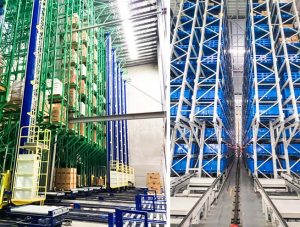
Semi-Automated Pallet Shuttle System
A pallet shuttle system combines high-density pallet racking, shuttle carts, rails, and WMS/WCS software.
Forklifts handle pallet loading and unloading at the rack entrance, while the shuttle moves pallets deep into the storage lane.
How LIFO works:
- The latest pallet is placed at the front of the available storage position.
- Earlier pallets remain deeper inside the lane.
- During retrieval, the latest stored pallet is removed first.
- WMS/WCS controls shuttle tasks according to the required inventory sequence.
Key advantages:
- High storage density
- Reduced forklift travel inside storage lanes
- Suitable for large quantities of similar SKUs
- Multiple shuttles can support higher throughput
- Easier to expand than a fully automated AS/RS
This makes pallet shuttle storage particularly useful when warehouse inventory contains large quantities of relatively standardized products.
AGV/AMR with Drive-In or Push-Back Racking
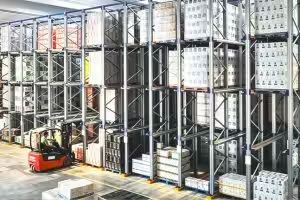
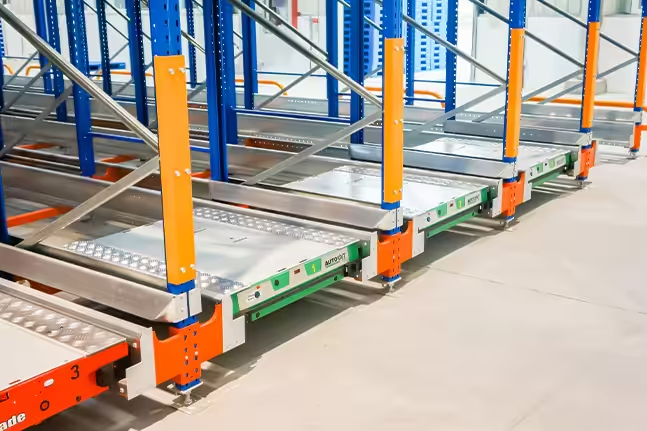
AGVs and AMRs can be integrated with dense storage systems such as drive-in racking and push-back racking.
Drive-in racking uses a single access side, while push-back racking uses nested carts that move along inclined rails.
How LIFO works:
- In drive-in racking, the last pallet stored at the rack entrance is normally the first pallet retrieved.
- In push-back racking, each new pallet pushes the previous pallet deeper into the lane.
- When retrieving inventory, the front pallet is removed first.
- AGVs or AMRs transport pallets between conveyors, staging areas, and storage locations.
Key advantages:
- High-density warehouse inventory storage
- Suitable for warehouses with limited floor space
- Flexible automation for existing facilities
- Reduced manual forklift operations
- Suitable for dynamic material-handling environments
AS/RS with LIFO Location Management
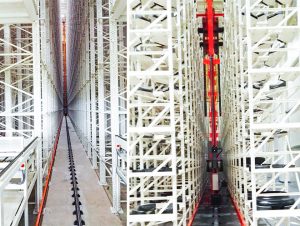
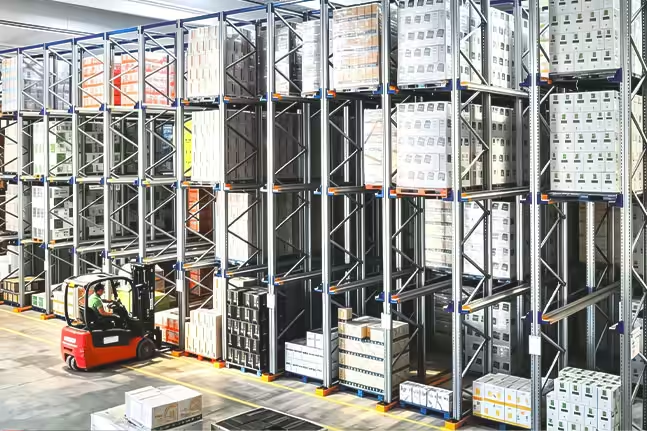
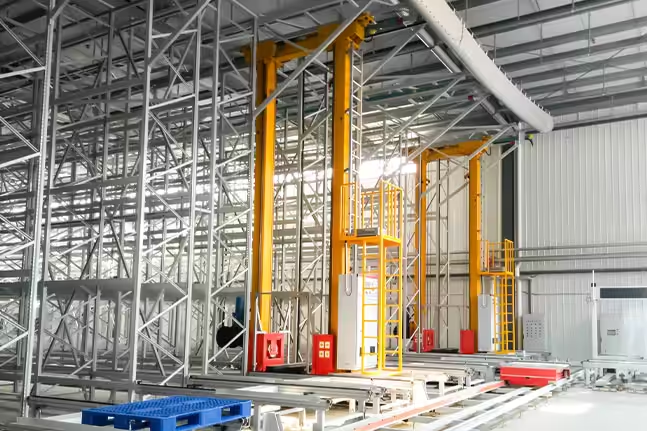
An Automated Storage and Retrieval System (AS/RS) can also support LIFO when its storage structure and WMS rules are configured accordingly.
A stacker crane can work with single-deep or double-deep pallet racking to automatically store and retrieve pallets.
How LIFO works:
The WMS assigns storage locations according to the required inventory sequence. When LIFO is enabled, the system prioritizes the most recently stored eligible pallet during retrieval.
For double-deep storage, the system must also consider pallet accessibility and crane fork configuration to ensure that the selected pallet can be retrieved safely and efficiently.
Key advantages:
- High storage density
- Precise inventory location management
- Fast automated storage and retrieval
- Reduced manual handling
- Suitable for large-scale warehouse inventory
Importantly, AS/RS is not inherently LIFO or FIFO. The actual inventory sequence is determined by the storage configuration and WMS strategy.
Dynamic Storage Systems
Push-back racking and other dynamic storage solutions can naturally support LIFO because pallets move toward the picking face as storage positions change.
When integrated with conveyors, automated forklifts, AGVs, or other material-handling equipment, the system can automate pallet movement between storage and staging areas.
| Storage System | Access & LIFO Suitability | Main Advantage |
|---|---|---|
|
Drive-In Racking |
Single side / High |
Very high density |
|
Push-Back Racking |
Single side / High |
Fast loading and retrieval |
|
Pallet Shuttle |
Usually single side / High |
High density with automation |
|
AS/RS |
Automated / Configurable |
High accuracy and throughput |
|
Gravity Flow Racking |
Usually two sides / Low for LIFO |
Better suited to FIFO |
The Role of WMS and WCS
Storage equipment alone does not determine the inventory sequence.
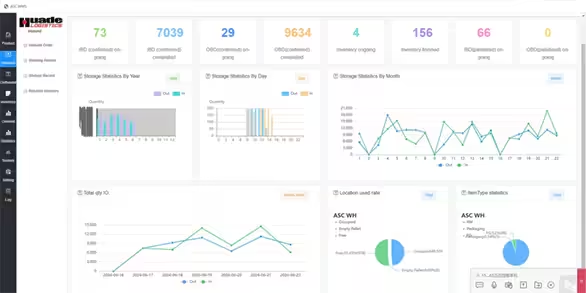
The Warehouse Management System (WMS) manages inventory rules, location assignment, and retrieval priorities, while the Warehouse Control System (WCS) coordinates automated equipment.
Key functions include:
- LIFO/FIFO rule configuration
- Dynamic storage location assignment
- Inventory age and batch tracking
- Equipment task scheduling
- Route and travel optimization
- Real-time inventory status updates
The system should also prevent equipment conflicts and unnecessary travel while maintaining the required inventory sequence.

LIFO and Warehouse Inventory: Key Benefits
When applied to the right warehouse inventory, LIFO can provide several operational benefits.
1. Higher Storage Density
LIFO is particularly compatible with high-density storage structures where pallets are stored several positions deep.
Drive-in, push-back, and pallet shuttle systems can reduce the need for individual forklift aisles and make better use of available floor space.
This can increase warehouse inventory capacity without expanding the building footprint.
2. Faster Material Flow
LIFO can simplify retrieval because the latest stored pallet is positioned for relatively direct access.
With automated shuttles, AGVs, or stacker cranes, the system can execute retrieval tasks with predictable movement patterns.
This can improve throughput when large quantities of similar warehouse inventory are handled regularly.
3. Better Fit for Specific Inventory Profiles
LIFO can work well for products that:
- Have no strict expiration requirements
- Are standardized and stored in large batches
- Have relatively stable product specifications
- Are stored for short periods
- Are not highly sensitive to inventory age
Typical examples include certain raw materials, metal products, building materials, and industrial components.
4. Potentially Lower Equipment Travel
A well-designed LIFO storage strategy can create relatively predictable material flows.
When WMS and WCS coordinate storage locations and equipment movements effectively, unnecessary travel and repositioning can be reduced.
This may contribute to lower energy consumption and equipment wear over time.
5. Simplified Inventory Flow
LIFO provides a clear retrieval sequence for suitable inventory.
When integrated with WMS, warehouse operators can track which pallet entered the system most recently and prioritize it automatically during retrieval.
However, inventory visibility still depends on accurate scanning, location management, and system data.
ABC Analysis and LIFO Warehouse Inventory
ABC analysis classifies warehouse inventory according to factors such as demand frequency, annual consumption value, or business importance.
LIFO/FIFO, on the other hand, defines how inventory should flow through the warehouse.
Therefore, ABC classification and LIFO/FIFO should be treated as two different decision layers.
| Strategy | Main Question | Example |
|---|---|---|
|
ABC Analysis |
How important is the inventory? |
A, B, or C |
|
FIFO |
Which inventory should leave first? |
Oldest eligible stock |
|
LIFO |
Which inventory should leave first? |
Newest eligible stock |
|
FEFO |
Which inventory should leave first? |
Earliest expiry |
Combining these rules allows a warehouse to balance inventory availability, storage density, and operating efficiency.
A-Class Inventory
A-class warehouse inventory usually has high demand, high consumption value, or significant operational importance.
These products are often positioned closer to input/output areas to reduce equipment travel.
However, high turnover does not automatically mean LIFO is appropriate.
For example, food, beverages, pharmaceuticals, and other expiry-sensitive products may require FIFO or FEFO even when they are classified as A items.
LIFO may be appropriate when A-class inventory is:
- Standardized
- Non-perishable
- Batch-flexible
- Frequently replenished and consumed
- Not subject to strict aging requirements
B-Class Inventory
B-class inventory provides greater flexibility.
Depending on product characteristics, it can use LIFO, FIFO, or a hybrid strategy.
WMS can divide B-class inventory into different storage zones and apply different retrieval rules according to product attributes.
C-Class Inventory
C-class inventory generally consists of lower-value or slower-moving items.
Because these products occupy storage locations for longer periods, high-density systems such as push-back, drive-in, or pallet shuttle racking can be useful.
However, the choice between LIFO and FIFO should still depend on inventory characteristics rather than ABC classification alone.
For slow-moving products with aging risks, FIFO or FEFO may be more appropriate.
For non-perishable materials where storage density is the priority, LIFO can be a practical option.
How to Design a Warehouse with ABC + FIFO/LIFO
A warehouse does not necessarily need to use one inventory strategy across the entire facility.
A more practical approach is to divide the warehouse into zones and assign different storage and inventory rules according to product characteristics.
Match Storage Locations with Inventory Rules
Different inventory profiles can be matched with different storage systems.
| Inventory Profile | Recommended Strategy | Possible Storage System |
|---|---|---|
|
A + high turnover + expiry-sensitive |
FIFO/FEFO |
Pallet Flow Racking |
|
A + high turnover + non-perishable |
FIFO/LIFO |
Pallet Rack / AS/RS |
|
B + moderate turnover |
FIFO/LIFO |
Pallet Shuttle / AS/RS |
|
C + slow-moving + non-perishable |
LIFO |
Push-Back / Drive-In |
|
C + aging-sensitive |
FIFO/FEFO |
Selective / Flow Racking |
The objective is not to force every warehouse inventory category into LIFO.
Instead, the goal is to match inventory characteristics, storage density, equipment capabilities, and retrieval rules.
Configure Dynamic Location Assignment
WMS can automatically assign storage locations based on:
- ABC classification
- Inventory age
- Batch number
- Product characteristics
- Storage capacity
- LIFO/FIFO requirements
- Equipment availability
This creates a dynamic location strategy rather than relying entirely on fixed warehouse locations.
Review ABC Classification Regularly
ABC classification should not remain unchanged for years.
Demand patterns, product portfolios, and warehouse inventory turnover can change over time.
Many operations review ABC classifications periodically and adjust storage zones and WMS rules accordingly.
This prevents high-demand products from remaining in inefficient locations and reduces unnecessary equipment travel.
Match Physical Storage with Software Rules
The physical storage system must support the inventory strategy configured in WMS.
For example:
- FIFO: Pallet flow racking or two-sided flow systems can support physical FIFO movement.
- LIFO: Drive-in, push-back, and pallet shuttle systems can support high-density LIFO storage.
- Flexible automation: AS/RS can switch between different retrieval strategies through software configuration, provided the physical storage design supports them.
The best warehouse inventory strategy is therefore a combination of physical design and software logic, not software configuration alone.
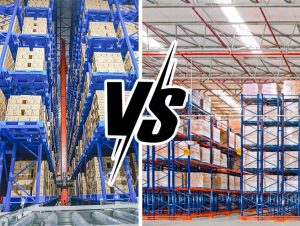
LIFO vs. FIFO: Which Is Better for Warehouse Inventory?
Neither LIFO nor FIFO is universally better.
The right method depends on product characteristics, inventory aging requirements, storage density, and operational priorities.
| Factor | LIFO | FIFO |
|---|---|---|
|
Storage Density |
High |
Moderate to High |
|
Expiry & Batch Control |
Generally unsuitable; limited control |
Preferred; strong control |
|
Racking Compatibility |
Drive-in well suited; pallet flow limited |
Drive-in limited; pallet flow excellent |
|
Warehouse Automation |
Supported |
Supported |
|
Best For |
Non-perishable inventory |
Age-sensitive inventory |
For warehouse inventory with strict shelf-life requirements, FIFO or FEFO should generally take priority over storage density.
For non-perishable inventory where maximum storage density is the main objective, LIFO can be a more practical choice.
Conclusion
LIFO can be an effective warehouse inventory strategy when it matches the physical characteristics and operational requirements of the products being stored.
High-density systems such as drive-in racking, push-back racking, pallet shuttle systems, and appropriately configured AS/RS can support LIFO while improving space utilization and material flow.
The most effective approach is not simply choosing LIFO over FIFO.
Instead, combine ABC classification, inventory characteristics, storage equipment, WMS rules, and automation technology to create a warehouse strategy that balances storage capacity, throughput, inventory control, and operating cost.
Need a LIFO Warehouse Inventory Solution?
Looking for a high-density storage system that fits your warehouse inventory and LIFO requirements? Contact HUAYIDE for a customized storage solution, including racking selection, automation planning, and WMS/WCS integration.