Introduction
As warehouses handle more small parts, totes, cartons, and individual items, traditional storage methods can struggle with space utilization, picking efficiency, and inventory accuracy. ASRS totes provide an automated way to store, retrieve, and move these goods while making better use of available warehouse space.
Different tote storage systems use different technologies, including stacker cranes, shuttle vehicles, mobile robots, and vertical storage equipment. Each option has different requirements for storage density, throughput, building conditions, and order-picking operations.
In this guide, we cover 13 types of ASRS tote storage systems, how they work, their key advantages, and the applications they are best suited for.
1. Miniload Stacker Crane AS/RS
A Miniload Stacker Crane AS/RS uses an automated stacker crane to store and retrieve totes from multi-level racking. The system typically combines storage racks, a tote stacker crane, conveyors, a Warehouse Control System (WCS), and a Warehouse Management System (WMS).
During operation, the WMS manages inventory and storage locations, while the WCS coordinates the stacker crane and material handling equipment. Based on each storage or retrieval instruction, the stacker crane automatically moves totes between the storage locations and the inbound or outbound stations.
Depending on the application, the stacker crane typically handles tote loads of around 25–100 kg, although the capacity can be customized for specific requirements. Totes can be stored individually or in stacked configurations, depending on the rack design, tote dimensions, and handling requirements.
Key Advantages
- High Storage Density: The shuttle-based rack design makes full use of available vertical and horizontal space, allowing more totes to be stored within the same warehouse footprint.
- High Throughput: Multiple shuttle vehicles can operate across different storage lanes and levels, helping the system handle frequent tote storage and retrieval operations.
- Flexible Configuration: The number of shuttle vehicles, storage levels, lifts, and workstations can be configured according to actual throughput and capacity requirements.
- Easy to Scale: When business volume increases, the system can be expanded by adding shuttle vehicles or adjusting related material handling equipment instead of completely redesigning the storage area.
- Suitable for Goods-to-Person Operations: Totes can be automatically transferred from storage to picking stations, reducing unnecessary walking and searching. This makes the system suitable for piece picking, replenishment, order consolidation, and other high-frequency warehouse operations.
2. Two-Way Tote Shuttle AS/RS
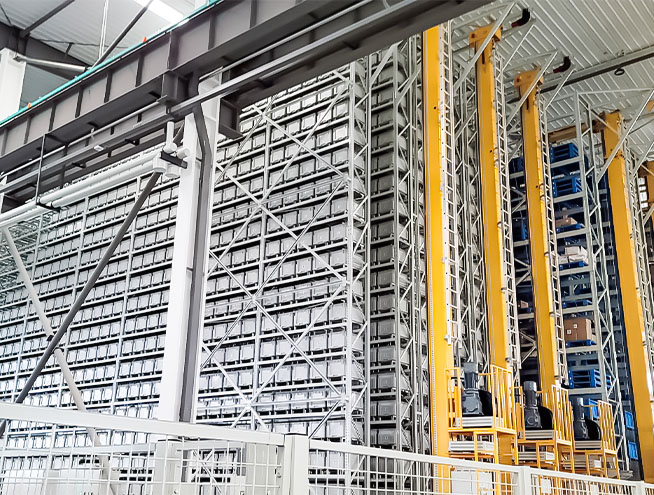
A Two-Way Tote Shuttle AS/RS uses shuttle vehicles to move totes back and forth inside storage racks. The system typically includes tote racks, shuttle vehicles, lifts, conveyors, WMS, and WCS.
The shuttles handle movement within each storage level, while lifts move totes or shuttles between levels. This allows totes to be automatically stored and retrieved with less manual handling.
Key Advantages
- High storage density: Makes better use of vertical space and stores more totes in a limited area.
- Fast storage and retrieval: Multiple shuttles can handle totes efficiently across different storage levels.
- Flexible configuration: The number of shuttles can be adjusted according to storage capacity and throughput needs.
- Easy to expand: The system can be expanded as business volume and storage requirements grow.
- Good for small-item picking: It works well for e-commerce, retail, spare parts, and other operations that handle many small items.
3. Four-Way Tote Shuttle AS/RS
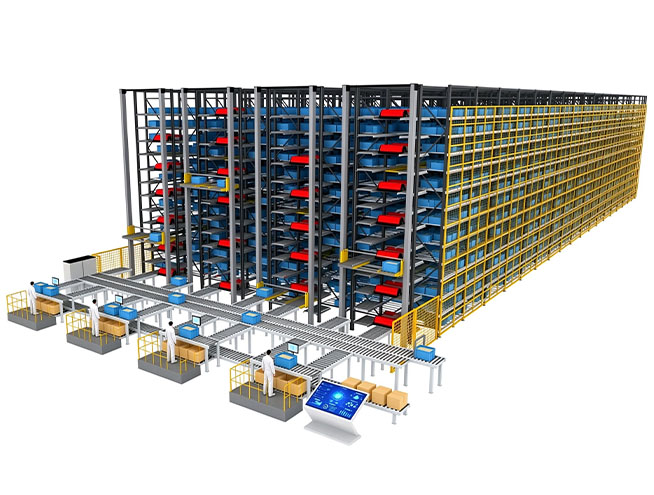
A Four-Way Tote Shuttle AS/RS builds on the two-way shuttle design and allows shuttle vehicles to move forward, backward, left, and right. The system typically includes high-density storage racks, four-way tote shuttles, lifts, conveyors, and a central control system.
Because the shuttles can move in multiple directions, they can reach different storage locations without relying on a fixed travel path. In goods-to-person picking operations, the system automatically delivers totes to picking stations. Workers simply pick the required quantity shown on the workstation and place the items into the order container.
A single shuttle aisle can reach up to 1,000 totes per hour or more under suitable operating conditions, depending on the system configuration and workload.
Key Advantages
- Flexible movement: Four-way shuttles can move in multiple directions, making it easier to arrange storage locations and adapt the system to different layouts.
- High storage density: Dense rack layouts make better use of available warehouse space.
- Fast picking: Totes can be delivered directly to picking stations, reducing walking and searching time.
- High throughput: Multiple shuttles can work together to handle a large number of tote storage and retrieval tasks.
- Lower picking errors: Guided picking helps workers follow the required quantities and reduces manual searching and counting.
- Easy to scale: Shuttle numbers and other equipment can be adjusted as storage capacity and order volumes change.
4. Climbing Robot Tote Storage System
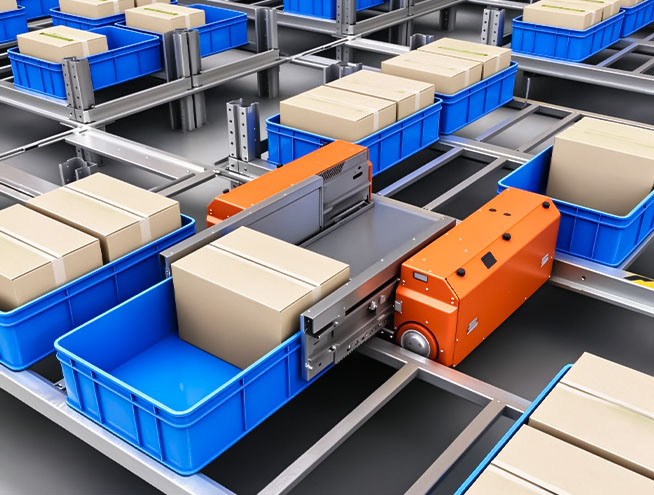
A Climbing Robot Tote Storage System uses mobile robots that can move along storage racks and climb between different levels. This allows the robots to reach totes stored at different heights without relying on a fixed stacker crane.
The system makes good use of vertical warehouse space while keeping the layout relatively flexible. It can be a practical option for growing businesses that need to deploy automation quickly and may need to expand storage capacity later.
Key Advantages
- Highly flexible: The number of robots can be increased or reduced according to changes in order volume and storage demand.
- Quick deployment: The system generally requires less modification to the existing warehouse floor and building structure, making it easier to put into operation.
- Good use of vertical space: Robots can access totes at different rack levels, helping increase storage capacity without expanding the warehouse footprint.
- Easy to scale: Additional robots can be introduced as business volume grows.
- Flexible layout: The system can adapt to different rack configurations and warehouse layouts.
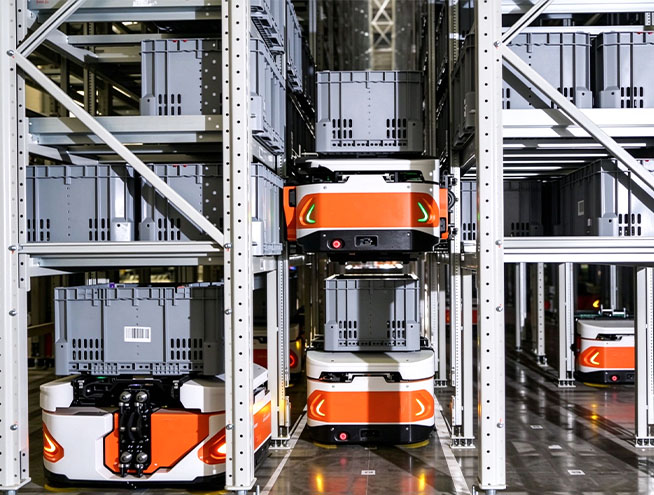
5. Amphibious Tote Shuttle System
An Amphibious Tote Shuttle System uses shuttle vehicles that can run both inside the storage racks and on the warehouse floor. This allows the same shuttle to move totes between storage locations and different operating areas without transferring them to another handling device.
By reducing equipment handoffs, the system can shorten transfer time and simplify the overall material flow. Its flexible movement also helps it adapt to more complex warehouse layouts and changing storage requirements.
Key Advantages
- Less equipment handoff: The shuttle can move between rack and floor areas directly.
- Faster material flow: Reduces transfer steps and connection time between different equipment.
- Flexible operation: Can adapt to different storage layouts and material flow requirements.
- Lower equipment needs: Reduces the need for additional transfer or connection equipment.
- Suitable for complex layouts: Useful where storage and handling areas require more flexible movement.
6. Vertical Tote Storage System
A Vertical Tote Storage System uses a vertical storage structure to store and retrieve totes efficiently. By making better use of the available height, it can increase storage capacity without taking up much additional floor space.
Key Advantages
- Better use of vertical space: Stores more totes within a limited floor area.
- High storage density: Makes full use of available warehouse height.
- Fast tote access: Supports quick storage and retrieval of totes.
- Space-saving design: Helps businesses increase capacity without expanding the warehouse footprint.
- Suitable for small-item storage: Works well for spare parts, e-commerce goods, medical supplies, and other tote-based inventory.
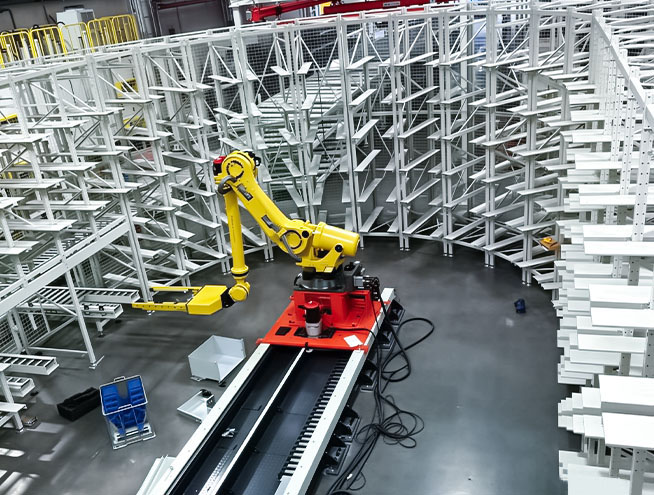
7. Circular Rack Tote Storage System
A Circular Rack Tote Storage System uses a circular rack layout that allows robots to move quickly between storage locations. The system uses robotic arms to pick and place totes, with some configurations able to handle two totes at a time.
With fast tote handling and dense storage, the system can support quick picking and order dispatch. Under suitable operating conditions, its handling capacity can reach up to 600 totes per hour.
Key Advantages
- Fast tote handling: Robotic arms quickly pick and place totes.
- High throughput: Some configurations can handle two totes in one operation.
- Dense storage: Makes efficient use of the available storage area.
- Fast picking and dispatch: Suitable for operations with frequent tote movement.
- Wide range of applications: Can be used in footwear and apparel e-commerce, retail, and similar industries.
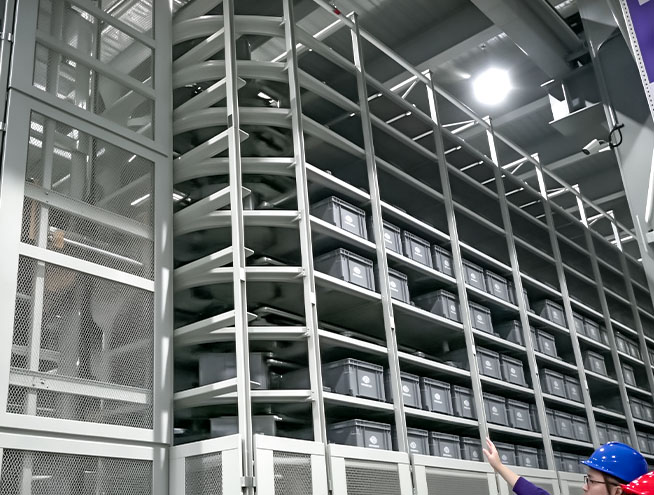
8. Rotating Rack Storage System
A Rotating Rack Storage System uses rotating storage units to bring the required goods to the operator or stacker crane. Instead of moving through the storage area to find each item, the system rotates the rack and presents the required storage position at the access point.
Key Advantages
- Easy access: Brings goods directly to the operator or handling equipment.
- Faster retrieval: Reduces the time needed to locate and access stored items.
- Efficient space use: Makes better use of vertical and storage space.
- Reduced movement: Minimizes unnecessary travel during picking and retrieval.
9. Tote Handling Robot Storage System
A Tote Handling Robot Storage System uses tote handling robots to automatically store, retrieve, move, and sort totes. The system can include high-precision rack structures, handling robots, WMS, AGV scheduling systems, and supporting software and hardware.
Similar to Miniload tote AS/RS, the robots use precise positioning to place totes in designated storage locations. This helps improve storage space utilization while reducing manual handling and inventory errors.
Key Advantages
- Automated tote handling: Supports automatic storage, retrieval, movement, and sorting.
- Precise positioning: Places totes accurately in their assigned locations.
- Better space utilization: Makes efficient use of available rack space.
- Faster order handling: Helps speed up picking, sorting, and packing operations.
- Wide applications: Can be used in e-commerce logistics, medical logistics, and workshop logistics.
- Reduced manual handling: Automates repetitive tote movement and handling tasks.
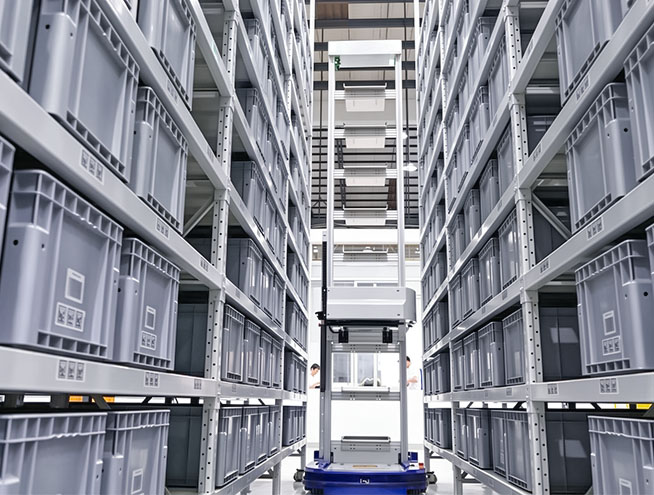
10. Spider Tote Picking Robot System
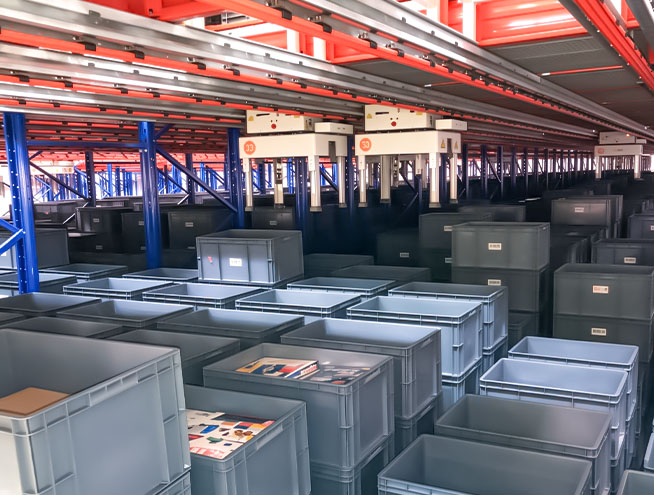
A Spider Tote Picking Robot System uses fast-moving robots to travel through storage aisles and pick totes from different storage locations. Instead of using a separate lift, the robot uses a flexible lifting mechanism to reach totes at different heights.
This design allows the robot to access a wide range of storage locations while keeping the system layout flexible.
Key Advantages
- Flexible tote access: The robot can reach totes at different storage levels.
- High storage density: Makes efficient use of vertical storage space.
- Wide working range: Supports different storage heights and operating requirements.
- Flexible layout: Allows more freedom when designing the storage area.
- Fewer navigation codes: Requires fewer floor navigation markers, which can simplify system deployment.
11. Floor-Stacking Tote Robot System
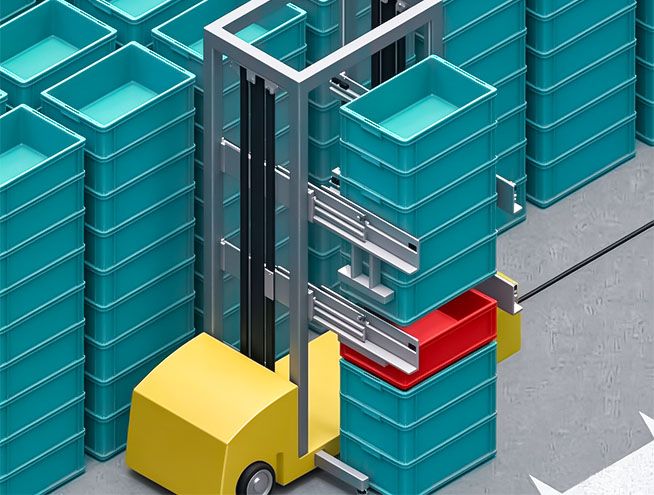
A Floor-Stacking Tote Robot System uses autonomous mobile robots to store and retrieve totes directly from floor-stacked storage. Unlike conventional tote storage systems, it does not require additional fixed racks or guide rails.
Totes can be stacked directly on the warehouse floor, while the robot can access individual totes from different positions within a stack. This makes the system highly flexible and easier to adapt to existing warehouse spaces.
Key Advantages
- No fixed racks required: Totes can be stored directly on the floor.
- Flexible deployment: Can work with existing warehouse infrastructure.
- Direct access to totes: The robot can retrieve individual totes from different positions in a stack.
- Flexible storage layout: Storage positions can be adjusted as requirements change.
- Good space utilization: Uses floor space efficiently while supporting automated tote handling.
12. Ultra-Mini Tote Storage System
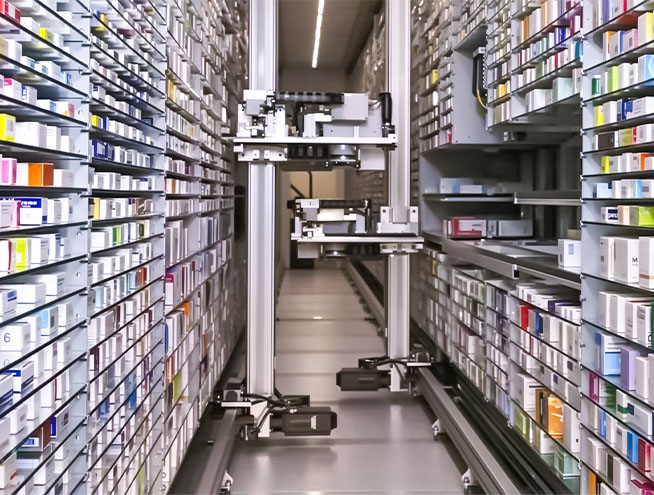
An Ultra-Mini Tote Storage System is designed for very small items that require frequent and fast storage and retrieval. It is especially useful in applications such as pharmacies, where many small items need to be handled efficiently.
Some systems use a compact dual-Miniload design to handle inbound and outbound totes. Two Miniload cranes can work together to increase handling capacity and support fast item access.
Key Advantages
- Designed for small items: Suitable for compact products and small inventory units.
- High throughput: Supports frequent inbound and outbound operations.
- Fast access: Helps quickly store and retrieve small-item totes.
- Compact design: Makes efficient use of available storage space.
- Suitable for pharmacies: Fits applications with many small items and frequent order handling.
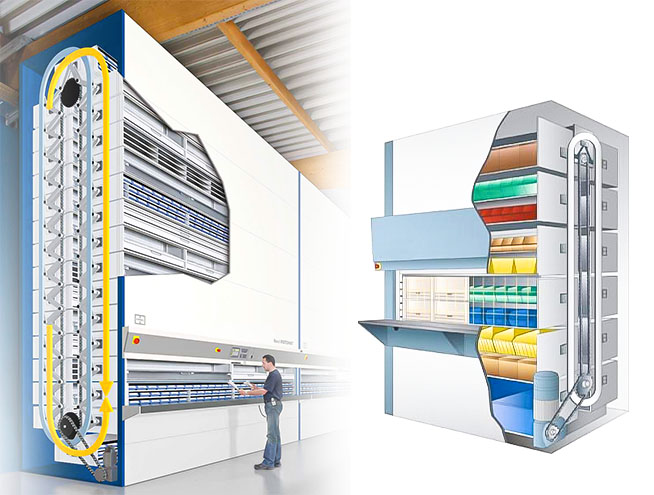
13. Vertical Carousel System
A Vertical Carousel System stores totes and other lightweight items in vertically arranged compartments. Each storage location can be divided into smaller sections and assigned a unique number.
When an operator enters the required location number on the control panel, the carousel rotates automatically and brings the selected compartment to the access opening. The operator can then store or retrieve the required item without searching through the entire storage area.
Key Advantages
- Easy item access: Automatically brings the required storage location to the operator.
- Good use of vertical space: Uses vertical height to increase storage capacity.
- Organized storage: Numbered compartments make it easier to locate individual items.
- Faster retrieval: Reduces manual searching and unnecessary movement.
- Suitable for lightweight items: Works well for totes, spare parts, tools, and other small materials.