Introduction
Choosing between a stacker crane ASRS and a four-way shuttle ASRS is an important decision when planning an automated warehouse. Both systems automate pallet storage and retrieval, reduce manual handling, and make better use of warehouse space. However, they differ in storage density, throughput, equipment configuration, and scalability.
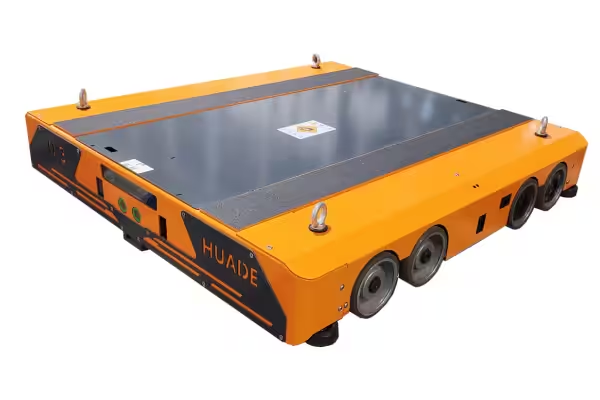
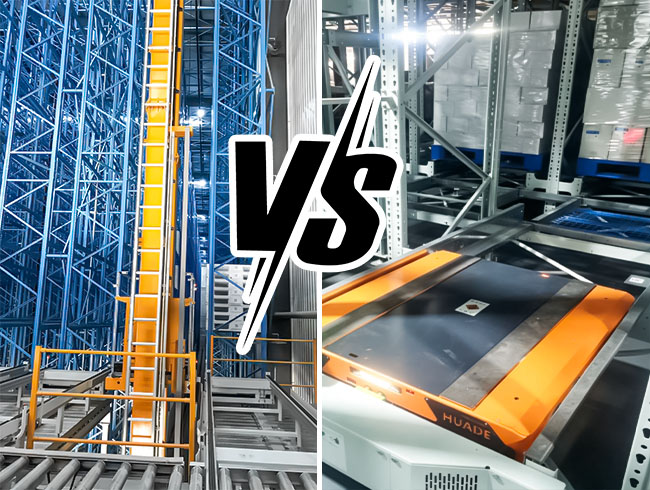
A stacker crane ASRS uses a dedicated crane to store and retrieve pallets within a fixed aisle. A four-way shuttle ASRS uses mobile shuttles that travel in both directions along a rack system, allowing multiple vehicles to work across different aisles and storage levels. These differences affect how each system handles daily operations, peak demand, and future expansion.
So, which solution is right for your warehouse? This guide compares stacker crane ASRS and four-way shuttle ASRS across six key areas: storage density, throughput, racking structure, storage and retrieval equipment, material handling, and long-term reliability and maintenance costs. By understanding the strengths and limitations of each option, you can choose a solution that fits your inventory, operational needs, warehouse layout, and budget.
Key Differences at a Glance
When planning a new automated warehouse, how do you compare a stacker crane ASRS with a four-way shuttle ASRS and identify the real advantages and limitations of each solution?
Although both systems automate pallet storage and retrieval, they differ in storage height, throughput, storage density, energy use, fault recovery, and expansion flexibility. The table below compares their key performance indicators, common maintenance issues, and typical applications to help you understand these differences and choose the right solution for your warehouse.
| Comparison Dimension | Stacker Crane ASRS (1-Ton Pallet) | Four-Way Shuttle ASRS (1-Ton Pallet) |
| Rack Height | Typically ≥20m, max. up to 45m | Typically ≤15m (limited by rack tolerance & structural design), a few cases reach ≥20m |
| Peak Throughput | 45 pallets/hour/aisle | Approx. 15 pallets/hour, throughput subject to shuttle quantity |
| Storage Density | High storage density (1.6m aisle space reserved for crane rail) |
Ultra-high storage density, cube-style compact slot storage |
| Power Consumption | Single unit: 20–30 kW | LFP battery specification: 48V/50Ah, battery rated power approx. 2.4 kW |
| Fault Recovery Time | Single-point failure has severe impact; the whole aisle must be shut down, recovery ≥4 hours |
Redundant shuttles enable rapid hot swap & recovery within ≤1 hour, except for severe aisle blockage |
| Scalability & Application Scope | High cost for physical expansion (new aisles required); ideal for new-build high-bay warehouses |
Modular scalability (add shuttles or rack bays); compatible with both new and existing warehouses |
| Typical Industry Verticals | Wide general applicability, customisable for extra-long & oversized unit loads |
Food, pharmaceutical, cold chain, beverage, chemical; suited for low-to-medium throughput & relatively limited SKU range; not suitable for extra-long & oversized cargo customisation |
| Common Failures | Photoelectric sensor failure, chain breakage, running wheel damage, high noise level; spare parts with high interchangeability |
Communication dropout, path planning deadlock, battery damage; spare parts with low interchangeability, OEM-dependent |
Storage Density Comparison
Storage Density of a Stacker Crane ASRS
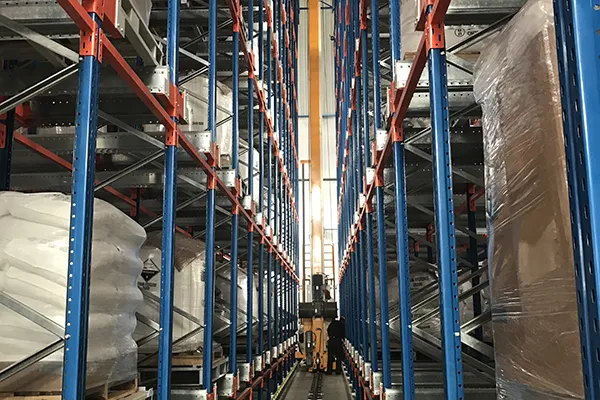
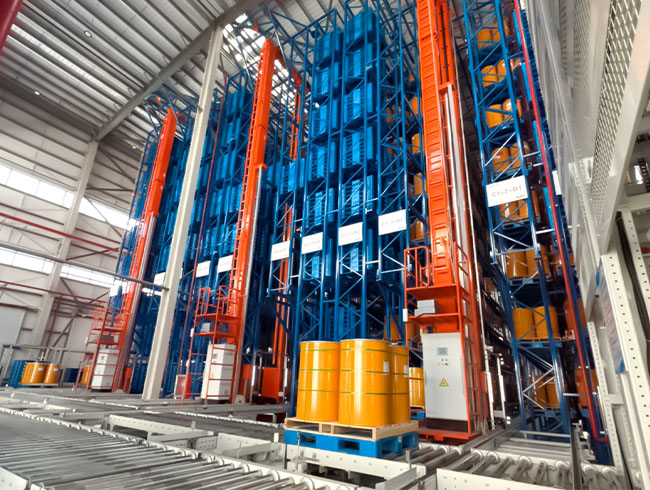
A stacker crane ASRS uses a fixed-aisle layout, with each crane operating in a dedicated aisle between rows of racks. Depending on the rack arrangement, one dedicated aisle may serve one or two rack rows. Aisle widths typically range from 1.8 to 2.5 meters, although some designs require 2–3 meters. These aisles take up floor space that could otherwise be used for storage.
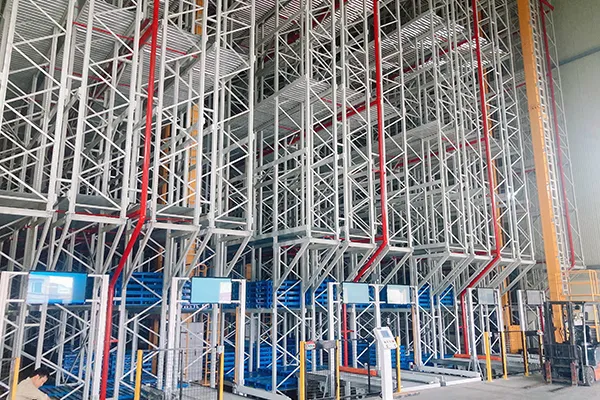
Compared with a traditional warehouse, an automated high-bay warehouse with stacker cranes can make much better use of vertical space. While conventional warehouses may have a space utilization rate of around 30%–40%, automated storage facilities can reach 80%–95% under suitable conditions. However, these figures depend on how space utilization is defined and the warehouse layout. For example, in a 1,000 m² warehouse, a stacker crane ASRS layout might allocate approximately 600–650 m² to the rack footprint, with the remaining area used for aisles, handling equipment, and operational zones.
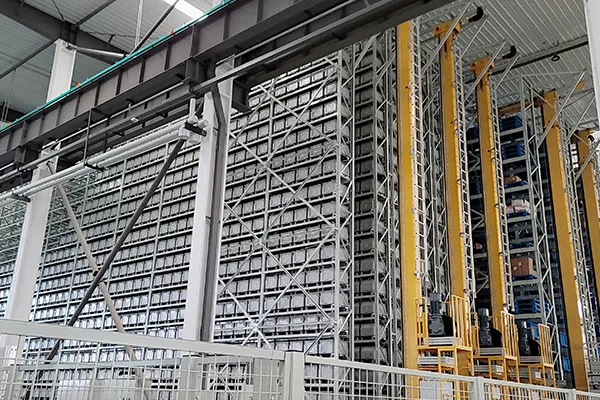
Stacker cranes can serve racks around 10–25 meters high or even taller, depending on the equipment design and project requirements. However, increasing rack height also raises structural and equipment requirements. Above 15 meters, factors such as mast stability, rail alignment, load handling, and installation accuracy become increasingly important, potentially increasing project costs. A taller warehouse can provide more pallet positions, but the final design must balance storage capacity, equipment performance, and investment.
Storage Density Advantages of a Four-Way Shuttle ASRS
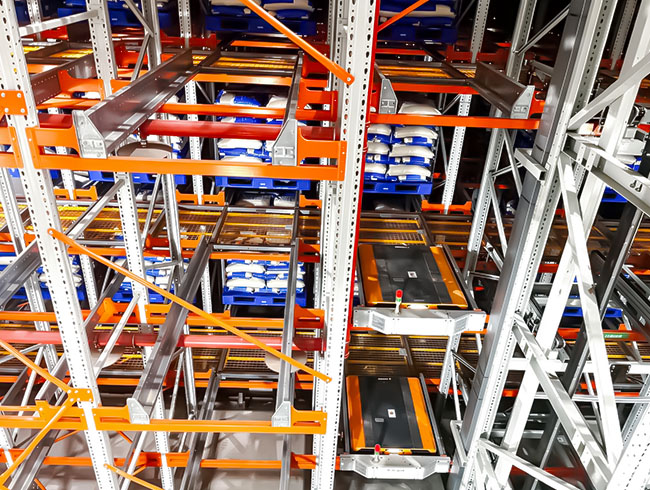
A four-way shuttle ASRS increases storage density by reducing the need for dedicated crane aisles. Four-way shuttles can travel both lengthwise and crosswise along the rack tracks, moving between aisles to access different storage locations. Instead of requiring a separate aisle for every crane, the system uses a dense rack layout with a limited number of main aisles for goods transfer and equipment access.
This design can significantly reduce the floor space allocated to aisles. Depending on the rack configuration and shuttle dimensions, the clearance between rack positions may be much narrower than a conventional crane aisle. Some designs use clearances of approximately 0.8–1.2 meters, while specialized configurations may require only 0.3–0.5 meters for shuttle travel. These figures refer to the relevant equipment clearances, not necessarily the width of a complete operating aisle.
For example, in a 1,000 m² warehouse, a four-way shuttle ASRS might achieve a rack footprint of 850–900 m² under a suitable layout. Compared with the 600–650 m² example for a stacker crane ASRS, this illustrates the potential to allocate more floor space to storage. Actual results will depend on fire protection, columns, conveyors, lifts, access requirements, and other site conditions.
Project data can also help illustrate the potential benefits of dense storage. The following examples are from specific applications and should not be treated as guaranteed results for every warehouse:
- Food storage: One food company’s storage density increased from 35 boxes/m² in its traditional warehouse to 130 boxes/m² after introducing a four-way shuttle system. The reported result illustrates how dense storage can accommodate substantially more goods within a limited footprint.
- Automotive spare parts: One distribution center reported a 75% improvement in space utilization and saved approximately 3,700 m² of storage area after adopting a four-way shuttle ASRS.
- 3C electronics manufacturing: One four-way shuttle warehouse reported a 350% increase in warehouse space utilization and a storage capacity of 10,337 pallet positions.
These results demonstrate the potential of four-way shuttle technology, but direct comparisons require consistent measurement methods and similar operating conditions.
Quantifying the Storage Density Difference
A four-way shuttle ASRS can provide higher storage density than a stacker crane ASRS, particularly when the warehouse uses deep-lane storage. Some project comparisons report storage capacity improvements of 30%–50%, while other estimates range from 20% to 60%. The actual difference depends on rack height, aisle layout, pallet dimensions, storage depth, and the space required for material handling.
Three factors help explain why a four-way shuttle ASRS can accommodate more pallets within the same building:
- More storage positions: Compared with a traditional floor-storage warehouse, an automated storage solution can provide several times as many pallet positions, depending on the available height and layout. A four-way shuttle system may also provide 30%–50% more positions than a comparable stacker crane layout in suitable applications.
- Less aisle space: By reducing the need for dedicated equipment aisles, four-way shuttle systems can allocate more of the warehouse footprint to racks. This is especially valuable when land is expensive or additional building space is difficult to obtain.
- Deeper storage lanes: Some four-way shuttle configurations support storage lanes holding 20 pallets or more in depth. Deep-lane storage can increase capacity within a given footprint, although SKU distribution, inventory access, and retrieval requirements must also be considered.
For businesses operating in urban industrial parks, high-cost logistics hubs, or cold storage facilities, these space savings can have a direct impact on warehouse planning. Storing more pallets in the same building may reduce the need for additional storage space and help control long-term facility costs. However, the best solution is not always the one with the highest storage density; throughput, inventory accessibility, and total investment must also be considered.
Throughput and Operational Efficiency Comparison
Operational Efficiency of a Stacker Crane ASRS
A stacker crane ASRS performs well in single-aisle operations, thanks to its mature technology and stable operating characteristics. Modern high-speed stacker cranes can reach horizontal travel speeds of 300 m/min and vertical lifting speeds of 120 m/min, with acceleration of up to 0.5 m/s². These capabilities allow a single stacker crane to complete 50–80 storage and retrieval cycles per hour, approximately 5–8 times the rate of manual operation.
Actual performance depends on the equipment configuration, travel distance, load conditions, and cycle definition. The following figures illustrate common performance ranges and higher-performance applications:
- Single-deep stacker crane: A single storage or retrieval cycle, from the starting point to the target location and back, typically takes 40–70 seconds, depending on the travel distance.
- Double-deep stacker crane: Retrieving or storing a pallet in a deeper position requires an additional telescopic movement and may involve reduced-speed operation. Cycle time can increase by approximately 30%–50%, reaching around 60–105 seconds.
- High-performance stacker crane: Some models can complete 80–120 storage and retrieval cycles per hour under suitable operating conditions.
- Single-command cycle: A single inbound or outbound operation can take less than 20 seconds in some configurations. Combined inbound and outbound throughput can reach 30–50 pallet movements per hour or more, depending on the system design.
However, increasing the throughput of a stacker crane ASRS often requires adding more aisles and cranes. In high-volume applications where combined inbound and outbound demand reaches 120 pallets per hour per aisle or more, additional aisles may be needed to meet throughput requirements. Although this approach can reduce storage density, it helps maintain the required operating capacity.
This dedicated-aisle configuration can also limit flexibility when demand increases significantly. Each crane primarily serves its assigned aisle, so expanding capacity may require additional equipment and physical space.
For example, after operational optimization, one automated warehouse achieved utilization rates of 64%, 68%, and 65% for its three fully loaded stacker cranes, respectively. The combined inbound and outbound capacity reached 187 pallet movements per hour. This case illustrates how scheduling and equipment utilization affect overall throughput, even in a well-optimized stacker crane ASRS.
Throughput Advantages of a Four-Way Shuttle ASRS
A four-way shuttle ASRS improves operational flexibility through multi-vehicle coordination and parallel processing. The system can allocate multiple shuttles to different tasks according to order volume and workload. For example, 10 shuttles can handle inbound storage, outbound retrieval, or inventory relocation across different aisles and storage levels.
Instead of relying on a single crane to serve each dedicated aisle, a four-way shuttle ASRS can coordinate multiple vehicles across the rack structure. This makes it easier to distribute workloads and adjust operating capacity as demand changes.
Its main efficiency advantages include path optimization, multi-vehicle coordination, and modular expansion.
1. Path Optimization
Four-way shuttles can switch between aisles through connecting tracks within the rack structure, reducing the need to rely on external conveyors for transfers between aisles. For example, after completing an inbound task in Aisle A, a shuttle may move directly to Aisle B to perform an outbound task.
With optimized routing, travel distances can be reduced by more than 50% in some applications. The control system calculates routes and assigns suitable shuttles based on factors such as distance to the target location and current task allocation, helping reduce unnecessary travel.
2. Multi-Vehicle Coordination
In a goods-to-person operation, the time for an individual four-way shuttle task can be reduced to less than 45 seconds in some configurations. Combined with intelligent scheduling and parallel operations, the system may improve overall efficiency by 2.5 times compared with a relevant baseline.
Multi-vehicle coordination can also improve operational efficiency by more than 30% in suitable applications. For goods-to-person picking, some configurations can achieve throughput of 500–1,000 boxes per hour per aisle.
These results depend on the number of shuttles, storage layout, lift capacity, order profiles, picking processes, and the definition of throughput. Shuttle travel speed alone does not determine the overall picking rate.
3. Modular Expansion
A four-way shuttle ASRS uses a distributed architecture in which multiple shuttles can operate simultaneously at different storage levels. Shuttles move independently in the X and Y directions, while vertical lifts connect different levels for cross-level transport.
This parallel operating model can increase system throughput and reduce bottlenecks. Businesses can also add or remove shuttles to respond to seasonal demand, changes in order volume, or other operational requirements. This allows capacity to be adjusted without necessarily rebuilding the entire storage structure.
A stacker crane ASRS remains a strong option for stable, predictable, high-volume operations. Its cycle times can be planned around a dedicated aisle, and it offers continuous operation and high positioning accuracy.
A four-way shuttle ASRS is often better suited to operations with changing workloads. During e-commerce promotions or seasonal peaks, for example, adding shuttles may allow a system’s inbound and outbound throughput to increase from a normal operating level of 300 pallets per hour to 800 pallets per hour in a suitable configuration.
The efficiency advantage of a four-way shuttle ASRS is not simply the number of vehicles in operation. Intelligent scheduling, route optimization, and multi-vehicle coordination also help reduce waiting time and unnecessary movement. These capabilities can improve how the warehouse responds to changing demand.
Ultimately, the right choice depends on the required throughput, operating pattern, equipment configuration, and expansion plans. A stacker crane ASRS can suit predictable, high-volume flows, while a four-way shuttle ASRS offers greater flexibility when multiple tasks must be handled in parallel.
Racking System Comparison
Racking System Features of a Stacker Crane ASRS
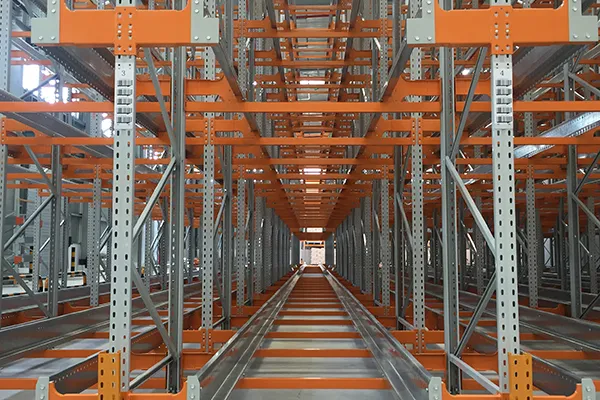
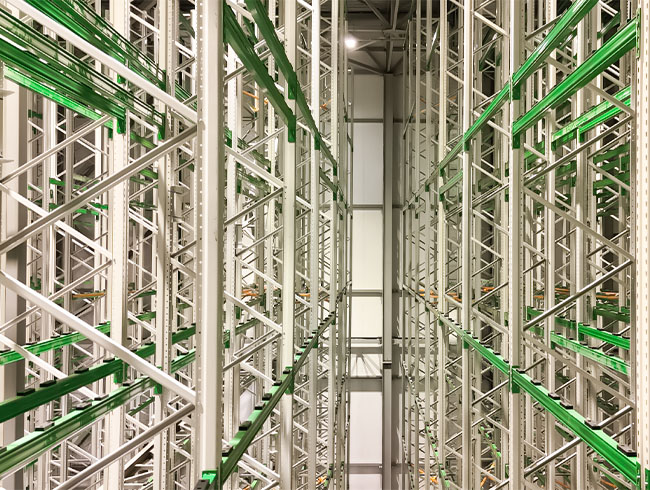
A stacker crane ASRS typically uses a beam-type racking structure combined with floor and overhead guide rails. This is a well-established design that provides stable support for stored loads and precise guidance for stacker crane movement.
The main components include uprights, beams, diagonal bracing, base plates, safety pins, tie rods, overhead rails, floor rails, and anti-collision barriers.
1. Structural Design
Stacker crane racking typically uses a beam adjustment pitch of 75 mm, allowing storage levels to be adjusted to suit different load heights. Its heavy-duty beam structure is designed to withstand substantial vertical and horizontal loads.
The uprights and beams are connected with high-strength bolts to form a stable frame. The overhead and floor rails guide the stacker crane along its aisle, supporting smooth travel and accurate positioning.
2. Installation
Installing a stacker crane racking system is relatively straightforward for an experienced installation team. The main steps include:
- Assembling the upright frames.
- Lifting the frames into position.
- Installing the beams, tie rods, and overhead and floor rails.
3. Maintenance
Stacker crane racking is relatively easy to maintain because its structure is straightforward and its components are highly standardized. Routine inspections mainly cover bolt tightness, rail wear, and structural deformation.
With a stable rack structure and reliable materials, routine maintenance can be kept manageable, helping control long-term maintenance costs.
Racking System Features of a Four-Way Shuttle ASRS
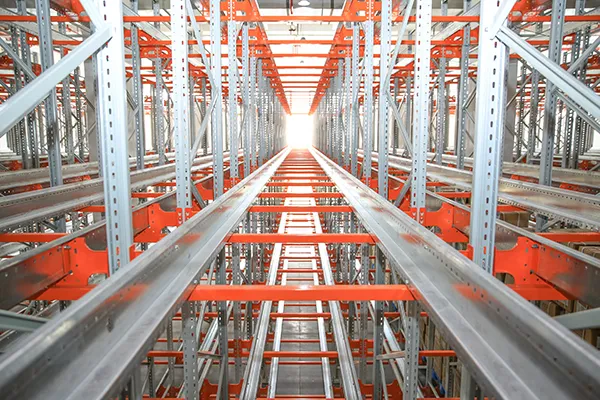
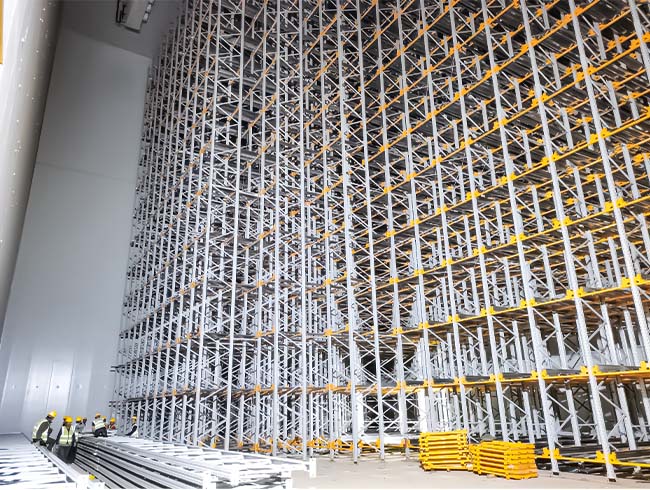
A four-way shuttle ASRS also uses beam-type racking, but its design has some important differences from a stacker crane ASRS. One key feature is its main and secondary rail system, which supports shuttle movement in both the longitudinal and transverse directions.
1. Main and Secondary Rail Structure
The racking system uses two types of rails, each with a specific function:
- Main rails: These are the primary running components for four-way shuttle movement. They are bolted to the uprights and use a C-shaped beam structure.
- Secondary rails: These guide the shuttle during pallet handling. They are bolted to connecting plates on the beams and use a δ-shaped section with a thickness of 3.0 mm.
This dual-rail design helps keep the shuttles stable during operation. It also helps distribute loads and improve the overall strength of the racking structure.
2. Overall Racking Structure
The upright frames form the main supporting structure of a four-way shuttle ASRS. They consist primarily of uprights and diagonal and horizontal bracing.
The racking uses a modular, assembled structure. The steel must provide sufficient stiffness and strength to meet the specified seismic requirements, including a seismic fortification intensity of 7 degrees.
The rack base plates are fixed on-site without embedded components. The upright frames are assembled using bolted connections, creating a fully assembled structure that can be configured, installed, and dismantled as needed. This design offers flexibility when assembling or modifying the racking layout.
3. Installation Complexity
Compared with a stacker crane ASRS, a four-way shuttle ASRS generally requires more specialized rack installation because the rail system must align precisely with the shuttle’s travel paths.
The main installation challenges include:
- High alignment accuracy: The level and vertical alignment of tracks across multiple storage levels must be carefully controlled.
- Specialized rail connections: Connecting and securing the main and secondary rails requires suitable tools and installation procedures.
- Professional commissioning: Qualified technicians must inspect, adjust, and test the rail system to ensure smooth shuttle movement.
More complex modifications: Changes to the rack layout or rail configuration can be costly because the track system is closely integrated with the racking structure.
Careful installation and commissioning are essential because rail alignment directly affects shuttle movement, positioning accuracy, and reliable operation.
4. Maintenance Challenges
The integrated rail structure of a four-way shuttle ASRS also creates specific maintenance requirements. Compared with a more conventional stacker crane racking structure, inspecting and repairing the shuttle tracks may require more specialized work.
Common maintenance challenges include:
- Rail wear and replacement: Inspecting and replacing worn rails can be difficult, particularly at higher storage levels.
- Rail alignment: The main and secondary rails must maintain the required alignment. If their positioning changes, troubleshooting and repairs can become more complicated.
- Structural coordination: Because the rails are closely integrated with the rack structure, some local repairs may require checks of adjacent components.
- Routine inspections: Regular maintenance should include checking rail wear, bolt tightness, and rail deformation to identify potential problems early.
Overall, a four-way shuttle ASRS relies on a specialized rail and racking design to support flexible, multi-directional shuttle movement. This design can support high-density storage, but it also places greater demands on installation accuracy, commissioning, and maintenance planning. When comparing a stacker crane ASRS with a four-way shuttle ASRS, businesses should consider not only storage capacity and throughput, but also the installation conditions and long-term maintenance requirements of each racking solution.
Overall Racking System Comparison
| Comparison Dimension | Stacker Crane ASRS | Four-Way Shuttle ASRS |
| Rack Structure | Beam-type rack with top & bottom guide rails |
Beam-type rack with primary & secondary guide rails |
| Construction Difficulty | Simple, standardised workflow | Complex, requires specialised technical expertise |
| Initial Investment | Relatively low | Relatively high |
| Post-operation Maintenance | Simple with low maintenance cost | Complex with high maintenance cost |
| Structural Stability | High, proven & reliable | High, with extremely stringent precision requirements |
| Retrofit Flexibility | Good, new aisles can be added | Poor, due to sophisticated rail system |
| Service Life | Long service life, over 20 years | Long service life, lifespan subject to maintenance quality |
A stacker crane ASRS offers a mature, straightforward racking design that is relatively easy to install and maintain. It is well suited to large-scale, standardized warehouse operations where stable performance, predictable workflows, and manageable maintenance costs are priorities.
A four-way shuttle ASRS requires a more specialized rail structure, making installation and maintenance more complex. However, its high-density storage layout and flexible multi-vehicle operation can provide significant advantages when warehouse space is limited or operating demands change frequently.
Storage and Retrieval Equipment Comparison
Technical Features of a Stacker Crane
A stacker crane is the core storage and retrieval device in a stacker crane ASRS. Its main characteristics are a complex mechanical structure and mature operating technology.
Over the years, stacker crane design has evolved from thin steel plate structures to welded box-type structures. Load capacity has increased from 500 kg to 2,000 kg in earlier development stages, while control systems have progressed from relay logic to PLC and variable-frequency drive combinations, and eventually to bus-based control systems.
1. Mechanical Structure
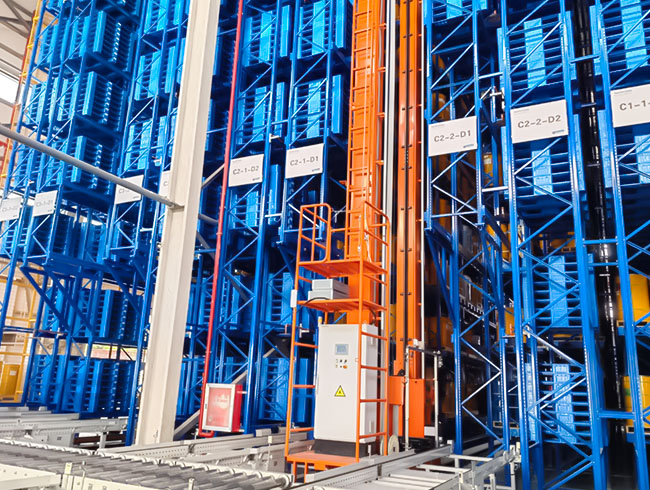
A stacker crane consists of several key mechanical components that work together to move and position loads accurately:
- Lower beam and travel mechanism: These components support the weight of the machine. Drive and driven wheels allow the stacker crane to travel horizontally along the floor rail in the aisle, providing smooth, high-speed, and low-noise movement along the X-axis.
- Mast: Modern stacker cranes commonly use a twin-mast structure to guide vertical movement. The masts need sufficient rigidity and stability to limit sway while handling loads.
- Lifting mechanism: Driven by wire ropes, chains, or synchronous belts, the lifting mechanism works with a high-performance lifting motor and encoder to position the load platform accurately.
- Fork mechanism: Mounted on the load platform, the fork extends and retracts horizontally along the Z-axis to pick up or deposit goods at the designated storage location.
These components work together through a three-axis motion system: horizontal travel, vertical lifting, and fork extension. This coordinated movement allows a stacker crane to position and handle loads accurately within three-dimensional storage space.
2. Technical Maturity
Stacker crane technology has developed over several decades and is now widely used in automated storage and retrieval systems. Its established mechanical design and control technology support precise, repeatable operations.
Key technical characteristics include:
- Positioning accuracy: Some configurations can achieve positioning accuracy of approximately ±1 mm.
- Horizontal travel speed: Modern high-speed stacker cranes can reach 300 m/min.
- Vertical lifting speed: Lifting speeds can reach 120 m/min.
- Load capacity: Depending on the model and configuration, stacker cranes can handle loads ranging from hundreds of kilograms to several tonnes. The original design range includes 2–5 tonnes for heavy-duty applications.
- High-speed operation: Some equipment specifications report travel speeds of up to 5 m/s and positioning accuracy of around 1 mm.
Compared with manual forklift operations, stacker cranes can improve handling efficiency and positioning consistency, particularly in high-bay warehouses with repetitive storage and retrieval tasks. Actual performance depends on the equipment model, travel distance, load, and operating cycle.
3. Maintenance Characteristics
Although a stacker crane has a complex mechanical structure, its mature technology makes routine maintenance and troubleshooting relatively straightforward.
Its main maintenance characteristics include:
- Established troubleshooting methods: Extensive application experience provides a useful foundation for fault diagnosis and repair.
- Standardized spare parts: Many components are standardized, making procurement and replacement easier.
- Routine maintenance: Regular work includes lubrication, fastening checks, cleaning, and inspection of moving components.
- Manageable maintenance procedures: Familiar equipment structures and established maintenance practices can help reduce troubleshooting time and simplify routine servicing.
When comparing a stacker crane ASRS with a four-way shuttle ASRS, stacker cranes offer the advantage of mature equipment technology and established maintenance practices. However, maintenance requirements still depend on the specific machine design, operating intensity, and availability of qualified service personnel.
Technical Features of a Four-Way Shuttle
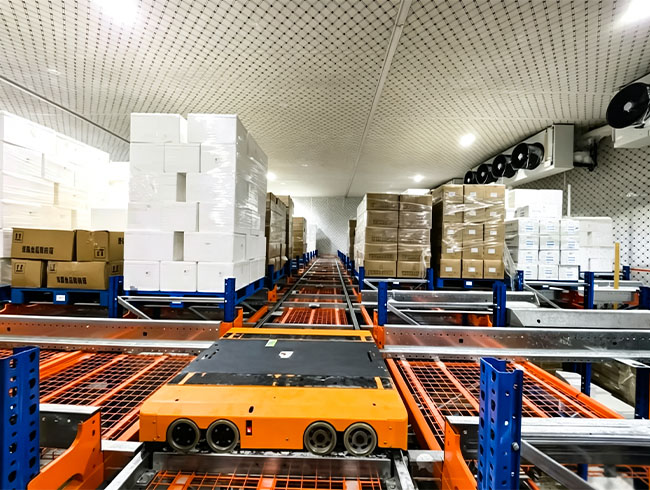
A four-way shuttle is an intelligent storage and retrieval device designed to move pallets in both the X and Y directions within a rack structure. Compared with a stacker crane, it has a more compact mechanical design, while much of its system complexity lies in software, multi-vehicle coordination, and control technology.
1. Compact Mechanical Structure
The four-way shuttle uses a relatively simple mechanical design to support flexible movement within a high-density racking system. Its main features include:
- Dual-wheel-system switching: The shuttle uses a lifting mechanism to switch between two wheel systems, allowing it to change travel direction and move along different rack tracks.
- Movement in two directions: The two wheel systems handle travel along the X and Y axes, enabling the shuttle to move both lengthwise and crosswise through the rack structure.
- Lightweight design: Its compact mechanical structure helps reduce equipment weight and energy consumption while supporting smooth movement.
- Compact dimensions: The shuttle body is approximately 0.6–0.8 meters wide. Its height can be adjusted to suit the rack level spacing, with some designs as low as 0.3 meters.
This compact design allows four-way shuttles to operate within narrow rack spaces, helping increase storage density and make better use of the available warehouse footprint.
2. Technical Barriers and System Compatibility
Although the shuttle’s mechanical structure is relatively compact, its control technology and system integration can present challenges.
- Specialized core technology: Key technologies may be concentrated among a limited number of manufacturers, creating technical barriers for other suppliers.
- Limited cross-vendor compatibility: Equipment and control systems from different manufacturers may use different communication protocols and interfaces, making integration more difficult.
- Dependence on manufacturer support: Maintenance, troubleshooting, and software updates may require the original manufacturer’s technical support, potentially increasing long-term service costs.
- Technology updates: Rapid product and software development may create challenges when upgrading older equipment or integrating it with newer systems.
For businesses comparing a stacker crane ASRS with a four-way shuttle ASRS, equipment compatibility and long-term technical support are important considerations alongside storage density and throughput.
3. Multi-Vehicle Coordination Challenges
The main complexity of a four-way shuttle ASRS often lies in coordinating multiple vehicles rather than in the mechanical structure of an individual shuttle.
- Complex scheduling algorithms: The control system must manage route planning, conflict avoidance, and task allocation across multiple shuttles.
- RCS software requirements: The Robot Control System (RCS) must process tasks and coordinate vehicle movements in real time.
- Reliable communication: The system requires stable, timely communication between shuttles and the control platform to support coordinated operations.
- Specialized commissioning and optimization: System testing, scheduling adjustments, and performance optimization require experienced technical personnel and a thorough understanding of the application.
As the number of shuttles and storage levels increases, scheduling and coordination become especially important. The system must balance equipment utilization, task priorities, travel distances, and potential congestion to maintain the required throughput.
4. Battery-Powered Operation
Four-way shuttles commonly use lithium batteries for power. This supports mobile operation within the rack structure but also introduces specific requirements for energy management and maintenance.
Key considerations include:
- Battery capacity and runtime: Available battery capacity and charging conditions affect how long a shuttle can operate before recharging.
- Charging and battery replacement: Charging schedules and battery replacement procedures must be planned to minimize interruptions to warehouse operations.
- Temperature sensitivity: Battery performance can be affected by temperature, making battery selection and thermal management particularly important in cold storage environments.
- Battery Management System (BMS): The BMS monitors battery conditions and helps protect against abnormal operating states, but it also adds another component that must be monitored and maintained.
These factors should be considered when planning a four-way shuttle ASRS, especially for facilities that operate continuously or handle goods in low-temperature environments.
Overall, a four-way shuttle combines a compact mechanical structure with sophisticated software, communication, and energy management requirements. When comparing a stacker crane ASRS vs a four-way shuttle ASRS, businesses should assess not only the equipment’s physical capabilities, but also system compatibility, scheduling performance, battery management, and long-term technical support.
Overall Comparison of Storage and Retrieval Equipment
Comparing the two technical solutions from the perspective of load handling equipment:
| Comparison Dimension | Stacker Crane ASRS | Four-Way Shuttle ASRS |
| Structural Complexity | Complex, 3-axis motion system | Simple, dual-wheel module design |
| Equipment Weight | Heavy, typically several tons | Light, 300–500 kg |
| Technical Maturity | High, decades of development | Medium, under rapid development |
| Maintenance Difficulty | Simple, open technical specifications | Complex, proprietary closed technology |
| Capital Cost | High, millions per unit | Low, hundreds of thousands per unit |
| After-sales Maintenance Cost | Low, high standardisation | High, OEM-dependent |
| Scheduling Complexity | Simple, single-device control | Complex, multi-device coordination |
| Positioning Accuracy | ±1 mm | ±2 mm |
| Travel Speed | 300 m/min (horizontal) | 60–100 m/min |
| Load Capacity | 1–5 tons | 1–2 tons |
Stacker cranes offer mature technology, stable performance, and straightforward maintenance, making them particularly suitable for applications where reliability is a top priority. Four-way shuttles feature a compact structure, high flexibility, and high space utilization, making them ideal for applications that require high storage density and flexible task scheduling.
Material Handling Equipment Comparison
Material Handling Equipment in a Stacker Crane ASRS
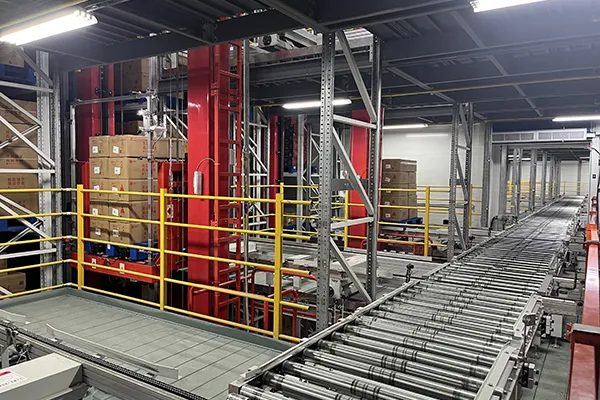
A stacker crane ASRS typically uses a conveyor system for material handling. This is a mature and reliable solution for moving goods between different warehouse areas.
The conveyor system acts as a transport network within the automated warehouse. It includes roller conveyors, chain conveyors, transfer units, vertical lifts, and sorting equipment. Together, these components connect inbound and outbound stations, sorting areas, production workshops, and stacker crane aisles.
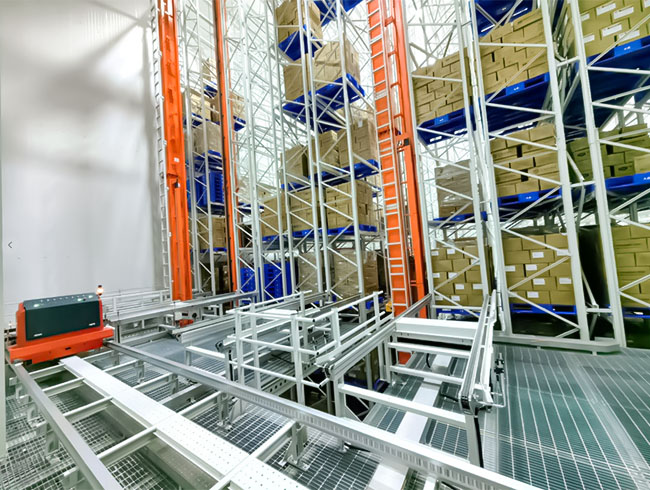
1. Conveyor Types and Their Features
Common conveyor types used in a stacker crane ASRS include:
- Roller and chain conveyors: These are widely used for heavy-duty material handling because of their high load capacity and stable operation. They mainly handle palletized goods during inbound, outbound, and transfer operations.
- Belt conveyors: Designed for lightweight loads such as cartons and small items, belt conveyors offer low-noise operation and low wear. They are commonly used in e-commerce, personal care, and other light-duty sorting applications.
- Vertical lifts: These lifts handle height differences and transfers between warehouse levels. By connecting vertical and horizontal conveying equipment, they form an integrated material handling network.
2. System Integration Advantages
The material handling equipment in a stacker crane ASRS offers several advantages:
- Mature technology and high equipment reliability.
- Strong system integration, with conveyors working seamlessly with stacker cranes.
- Straightforward maintenance and easy access to spare parts.
- Relatively low investment costs.
3. Operating Process
The material handling process in a stacker crane ASRS is relatively simple and direct:
- Inbound: Goods are scanned and weighed before the conveyor system transfers them to the stacker crane pickup point.
- Storage: The stacker crane receives the control command and moves the goods to the assigned storage location.
- Outbound: The stacker crane retrieves the goods and delivers them to the aisle transfer point. The conveyor system then moves them to the sorting area or outbound station.
This point-to-point conveying method provides clear transport routes and simple control logic, helping reduce the likelihood of equipment failures.
Material Handling Equipment in a Four-Way Shuttle ASRS
A four-way shuttle ASRS typically combines vertical lifts and conveyor systems to handle material movement. This configuration is designed to meet the specific requirements of a multi-level shuttle system, supporting both vertical transport between storage levels and horizontal movement between the warehouse and external operating areas.
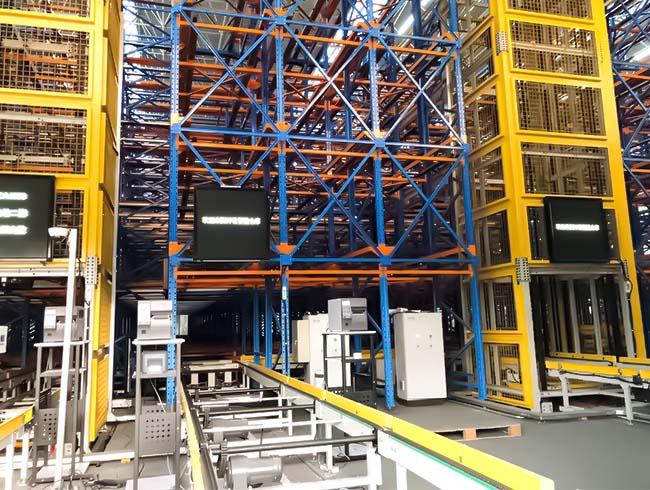
1. Lift System
The lift is a key component of a four-way shuttle ASRS, connecting different storage levels and enabling shuttle or pallet transfers between floors.
- Lift structure: Chain-driven or belt-driven lift systems are commonly used, with lifting speeds reaching 0.5–1 m/s.
- Seamless shuttle integration: The lift works with the shuttle system to support continuous transfers between storage levels.
- Pallet and shuttle transport: In addition to moving goods vertically, some lift configurations can also carry the shuttles themselves between levels.
- Accurate positioning and docking: Stable operation and precise positioning allow the lift to align with the shuttle system. Signal-based coordination enables automatic docking and transfer.
2. Conveyor System
The conveyor system connects internal warehouse operations with external material handling processes. It transfers goods into the shuttle operating area and moves retrieved goods toward the outbound station.
Typical equipment includes:
- Conveyor equipment and sorting machines.
- Inbound conveyors that move goods from outside the warehouse to the shuttle operating area.
- Outbound conveyors that transfer retrieved goods from the shuttle system to the dispatch area.
- Roller conveyors, belt conveyors, and AGVs used in inbound and outbound material handling.
The specific equipment configuration depends on the warehouse layout, load type, and material flow requirements.
3. System Complexity
Compared with a conveyor system serving a stacker crane ASRS, material handling in a four-way shuttle ASRS involves more coordination between lifts, shuttles, and conveyors. Key considerations include:
- Potential lift bottlenecks: Lifts can become bottlenecks if their capacity does not match the required throughput. The number and capacity of lifts must therefore be planned carefully.
- Coordinated equipment control: Multiple devices must work together with precise timing to maintain smooth material flow.
- Higher maintenance costs: Maintenance costs may be slightly higher than those of a conveyor-only transfer arrangement because more equipment and control functions are involved.
- Higher investment costs: The additional lifts, control interfaces, and coordinated equipment generally increase the initial investment.
4. Operating Process
The material handling process in a four-way shuttle ASRS involves several coordinated steps:
- Inbound: The conveyor system transfers goods to the lift.
- Vertical transfer: The lift moves the goods to the target storage level.
- Storage: The shuttle on that level collects the goods and moves them to the assigned storage location.
- Outbound: The process runs in reverse, with the system coordinating shuttle movements, lift availability, and transfer routes to retrieve and deliver the goods.
This multi-level, multi-device operating model increases system complexity but also provides greater flexibility and scalability. By coordinating lifts, shuttles, and conveyors, a four-way shuttle ASRS can support flexible material flows across multiple storage levels.
Overall Comparison of Material Handling Equipment
From the perspective of material handling equipment, the two technical solutions can be compared as follows:
| Comparison Dimension | Stacker Crane ASRS | Four-Way Shuttle ASRS |
| Main Equipment | Conveyor | Elevator + Conveyor |
| System Complexity | Low | High |
| Capital Cost | Low | Slightly higher |
| Maintenance Cost | Low & straightforward | Slightly higher & complex |
| System Bottleneck | Few | Elevator may become the throughput bottleneck |
| Flexibility | Moderate | High, cross-floor operation available |
| Scalability | Good, expandable by adding conveyors | Good, expandable by adding elevators |
| Reliability | High | High, yet dependent on elevator performance |
The material handling equipment in a stacker crane ASRS is simple, reliable, and relatively low-cost, making it well suited to single-level warehouses or multi-level facilities with limited vertical transfer requirements. In contrast, a four-way shuttle ASRS requires more complex and slightly more expensive material handling equipment, but its cross-level transfer capabilities and greater system flexibility offer clear advantages in multi-level automated warehouses.
Reliability and Maintenance Comparison
| Comparison Dimension | Stacker Crane ASRS | Four-Way Shuttle ASRS |
| Technical Maturity | Extremely high, proven by decades of field operation | Rapidly evolving, market growth stage |
| MTBF | ≥20,000 hours | ≥30,000 hours (high-end configuration) |
| System Availability | Above 99% | ≥99.5% |
| Failure Rate | 1% | Configuration-dependent |
| Maintenance Difficulty | Straightforward | OEM-dependent |
| Maintenance Cost | Low (15–20% of TCO) | Wide variance (5–20% of TCO) |
| Spare Parts Cost | Medium | High cost for high-end unit spare parts |
| Personnel Training | Simple, low training cost | Specialised training required |
| Downtime Risk | Low, quick repair achievable | Low, built with redundant design |
The comparison shows that a stacker crane ASRS has clear advantages in technological maturity and maintenance cost control. It is particularly suitable for businesses that prioritize reliability, have limited budgets, or have limited in-house maintenance capabilities.
A four-way shuttle ASRS offers advantages in advanced technology and system availability. It is better suited to businesses that require high storage density, are willing to invest more in advanced technology, and have the technical expertise to support system maintenance.
Conclusion and Selection Recommendations
After comparing stacker crane ASRS and four-way shuttle ASRS across six key areas—storage density, operational efficiency, racking systems, storage and retrieval equipment, material handling equipment, and technology maturity and reliability—we can draw the following conclusions.
Storage Density
A four-way shuttle ASRS generally offers a significant advantage in storage density, with 30%–50% more storage capacity than a stacker crane ASRS in comparable layouts. Some applications may achieve even higher gains. This advantage mainly comes from its dense racking layout and reduced need for dedicated equipment aisles.
Operational Efficiency
Both systems have their strengths. A stacker crane ASRS can achieve high throughput within a single aisle, typically handling 50–80 pallets per hour, making it suitable for stable, high-volume operations. A four-way shuttle ASRS supports parallel operations and flexible capacity expansion by adding more shuttles, making it particularly suitable for handling peak demand.
Racking Systems
A stacker crane ASRS uses a relatively straightforward racking structure that is easier to install and maintain, helping keep maintenance costs low. A four-way shuttle ASRS requires a more complex rack and rail structure, which can increase installation and maintenance costs. However, its high-density storage capability offers a significant advantage where warehouse space is limited or land costs are high.
Storage and Retrieval Equipment
Stacker cranes offer mature technology, stable performance, and straightforward maintenance. Four-way shuttles have a compact structure and high operational flexibility, but their control technology can be more closed, maintenance costs may be higher, and system performance depends heavily on software and multi-vehicle coordination.
Material Handling Equipment
A stacker crane ASRS typically uses a simple and reliable conveyor system, with relatively low investment and straightforward maintenance. A four-way shuttle ASRS combines lifts and conveyors. Although this configuration is more complex and generally costs more, it supports transfers between storage levels and offers greater flexibility in multi-level warehouses.
Technology Maturity and Reliability
A stacker crane ASRS benefits from mature technology, stable operation, and manageable maintenance costs. A four-way shuttle ASRS offers advanced automation and high system availability through multi-vehicle coordination and flexible task allocation. However, as the technology continues to evolve, businesses should also consider system compatibility, technical support, and long-term maintenance requirements.
Selection Framework
Based on the comparison above, the following guidelines can help you determine whether a stacker crane ASRS or a four-way shuttle ASRS is a better fit for your warehouse.
When to Choose a Stacker Crane ASRS
A stacker crane ASRS is generally a good choice for businesses with the following requirements:
- Storage needs: Standard pallet storage, a relatively small number of SKUs, and large-volume inventory.
- Operating patterns: Stable inbound and outbound flows with limited peak demand fluctuations.
- Reliability requirements: High system stability with minimal tolerance for frequent equipment failures.
- Investment budget: A limited budget and a strong focus on cost-effectiveness.
- Maintenance capabilities: Limited in-house technical expertise or maintenance resources.
When to Choose a Four-Way Shuttle ASRS
A four-way shuttle ASRS is generally more suitable for businesses with the following requirements:
- Storage needs: Very high storage density, especially where land and warehouse space are expensive.
- Operating patterns: Significant order fluctuations and the need to handle peak demand exceeding five times normal levels.
- Warehouse conditions: Multi-level facilities or warehouses with irregular layouts.
- Investment budget: Sufficient investment capacity and a willingness to pay more for advanced automation and flexibility.
- Maintenance capabilities: A strong technical team with the expertise to support system operation and maintenance.
These guidelines provide a starting point rather than a fixed rule. The final decision should also account for throughput targets, pallet specifications, building conditions, integration requirements, and long-term operating costs.
Final Recommendations
When selecting a warehouse automation solution, businesses should look beyond a simple comparison of technical advantages and disadvantages. The right choice depends on your operational requirements, business growth strategy, investment capacity, and existing technical capabilities.
A structured decision-making process can help reduce project risks and identify the most suitable solution:
- Define your requirements: Identify current warehouse challenges and forecast business needs over the next 3–5 years.
- Assess your current operations: Evaluate the existing warehouse layout, building conditions, technical infrastructure, and workforce capabilities.
- Match the technology to your needs: Shortlist suitable solutions based on storage density, throughput, operational flexibility, and reliability requirements.
- Calculate the total cost of ownership (TCO): Consider initial investment, operating expenses, maintenance costs, and other long-term costs.
- Assess potential risks: Review technology maturity, implementation challenges, system compatibility, and market-related risks.
- Validate through a pilot project: Test the proposed solution in a selected area to verify its feasibility and performance under actual operating conditions.
- Plan full implementation: Use the pilot results to refine the solution and develop a rollout plan for the entire warehouse.
Find the Right Warehouse Automation Partner
Choosing an experienced, one-stop warehouse automation partner can make the planning and implementation process much easier. HUAYIDE is a manufacturer of automated storage equipment and racking systems, providing automated storage and retrieval systems (AS/RS) and tailored warehouse solutions for industries worldwide.
Our services cover engineering consultation, system design, manufacturing, implementation, training, commissioning, and after-sales support. From initial planning to long-term operation, our team can help you identify a solution that fits your warehouse requirements and business goals.
Contact HUAYIDE for a free consultation with our expert team and get a customized warehouse automation solution for your business.