

Table of Contents
Contact Us
Recent Posts








Follow Us
Introduction
Choosing the right inventory picking strategy is an important part of efficient warehouse operations. The wrong approach can lead to inventory buildup, product expiration, unnecessary handling, and slower order fulfillment.
Common warehouse strategies include LIFO (Last In, First Out), FIFO (First In, First Out), random picking, batch picking, and wave picking. Each method serves different inventory characteristics, order volumes, and warehouse layouts.
In this guide, we will compare these strategies, explain where each one works best, and show how WMS (Warehouse Management System) can help optimize inventory flow and outbound operations.
Key Takeaways
- FIFO — Best for products with expiration dates or strict inventory rotation requirements.
- LIFO — Suitable for non-perishable goods, bulk materials, and certain stack-based storage applications.
- Random Picking — Provides flexibility for warehouses with many SKUs and fast-moving inventory.
- Batch Picking — Groups multiple orders to reduce repeated travel during picking.
- Wave Picking — Organizes picking tasks into scheduled waves to improve order fulfillment efficiency.
- WMS — Helps automate inventory allocation, picking tasks, stock tracking, and outbound processes.
Warehouse Picking Strategies at a Glance
The right picking strategy depends on product characteristics, inventory requirements, order volume, and warehouse operations. The table below provides a quick comparison of the most common approaches.
| Strategy | How It Works | Best For |
|---|---|---|
|
FIFO |
Oldest inventory is picked and shipped first |
Food, pharmaceuticals, chemicals; reduces expiration and aging inventory |
|
LIFO |
Most recently stored inventory is picked and shipped first |
Steel, timber, building materials, and other non-perishable goods |
|
Random Picking |
Available inventory is selected based on location, stock availability, and order requirements |
E-commerce, 3C, hardware, and high-SKU warehouses |
|
Batch Management |
Inventory is tracked and managed by production batch or lot number |
Pharmaceuticals, food, and chemicals requiring traceability |
|
Wave Picking |
Multiple orders are grouped into scheduled picking waves |
E-commerce, distribution centers, and high-volume outbound operations |
These strategies are not mutually exclusive. A warehouse can combine FIFO or LIFO inventory rules with batch or wave picking, while a WMS determines which inventory and picking tasks should be prioritized.
FIFO: First In, First Out
FIFO (First In, First Out) means the inventory that enters the warehouse first is picked and shipped first. This inventory rotation method helps maintain product freshness and reduces the risk of aging or expired stock.
A simple example is a supermarket refrigerator: older products are placed toward the front, while newer products are stored behind them. This allows customers to take the older stock first.
1. Which Industries Use FIFO?
FIFO is particularly suitable for products with expiration dates or limited shelf life, including:
- Food & beverage: Milk, drinks, canned food, and other packaged products
- Pharmaceuticals: Vaccines, prescription drugs, and healthcare products
- Chemicals: Paint, chemical materials, and other time-sensitive products
- Perishable goods: Fresh food, frozen food, and other temperature-sensitive products
2. Why Use FIFO?
- Prevent expiration: Older inventory is prioritized before newer stock.
- Reduce inventory loss: Products are less likely to deteriorate or become obsolete.
- Improve inventory rotation: Stock moves through the warehouse in a more controlled sequence.
- Support traceability: Time-based inventory rotation makes stock easier to monitor.
3. FIFO Example
Suppose a warehouse receives 100 bottles of Coca-Cola on June 1 and another 50 bottles on June 10. Under the FIFO method, the June 1 inventory should be picked and shipped first. Once those 100 bottles are sold, the warehouse then ships the 50 bottles received on June 10.
This simple approach ensures that older inventory leaves the warehouse before newer stock, helping reduce the risk of product expiration and inventory aging.
4. In short
FIFO is ideal for warehouses handling products with expiration dates, shelf-life requirements, or strict inventory rotation rules.

LIFO: Last In, First Out
LIFO (Last In, First Out) means the most recently received inventory is picked and shipped first, while older inventory remains in storage. For some businesses, this approach can reduce handling costs when newly arrived goods are easier to access than older stock.
1. Which Industries Use LIFO?
LIFO is mainly suitable for non-perishable products and storage environments where inventory rotation is less critical, such as:
- Stack-based storage: Building materials, coal, steel, and other bulk materials
- Non-perishable goods: Timber, bricks, metal raw materials, and similar products
- Bulk commodities: Petroleum products, aggregates, cement, and other large-volume materials
2. Why Use LIFO?
- Reduce handling costs: Newly arrived goods can be shipped directly without repeatedly moving older inventory.
- Suitable for heavy and bulky goods: Products such as steel and timber can be difficult and costly to rearrange.
- Improve handling efficiency: When the latest stock is easier to access, LIFO can simplify warehouse operations.
- Work with stack-based storage: Certain storage configurations naturally make recently stored goods easier to retrieve.
3. LIFO Example: Steel Inventory Management
Suppose a steel manufacturer receives one batch of steel on July 1 and another batch on July 20. If the company uses LIFO, when the steel is sold in August, the July 20 inventory is shipped first, while the July 1 inventory remains in storage.
This approach can reduce unnecessary handling, but it may also leave older inventory in storage for a longer period.
4. In short
Therefore, LIFO is generally more suitable for non-perishable goods and bulk materials than for products with strict shelf-life requirements.
Looking for warehouse storage solutions that support LIFO? Explore our detailed guide to learn which storage systems can work with LIFO inventory management and how they can improve storage density and handling efficiency.
LIFO Warehouse Inventory: Storage Systems, ABC Analysis & Automation
LIFO can be implemented through the combination of high-density storage equipment, automated material handling, and intelligent warehouse management systems.
Random Picking: Flexible Inventory Allocation
1. What Is Random Picking?
Random Picking means inventory does not follow a fixed outbound sequence such as FIFO or LIFO. Available products can be selected based on inventory location, order requirements, stock availability, and operational efficiency.
For warehouses with high SKU variety, this approach provides greater flexibility and allows inventory to be allocated according to current outbound needs.
2. Which Industries Use Random Picking?
- E-commerce: Small products with a large number of SKUs
- Hardware and office supplies: Products without strict shelf-life requirements
- 3C electronics and apparel: Fast-moving products with flexible inventory requirements
3. Why Use Random Picking?
- Improve picking efficiency: No need to follow a strict chronological sequence.
- Handle large orders and promotions: Inventory can be allocated flexibly according to demand.
- Improve inventory utilization: Different available stock locations can be used more efficiently.
4. Random Picking Example
Suppose an e-commerce warehouse processes 10,000+ orders per day and has 5,000 units of the same product stored across different rack locations. Instead of following FIFO or LIFO, the system can assign the most convenient available location based on the picking route and current order requirements.
5. In short
Random picking works well for warehouses with many SKUs, fast inventory turnover, and a strong need for operational flexibility.
Wave Picking: Optimizing Outbound Efficiency
1. What Is Wave Picking?
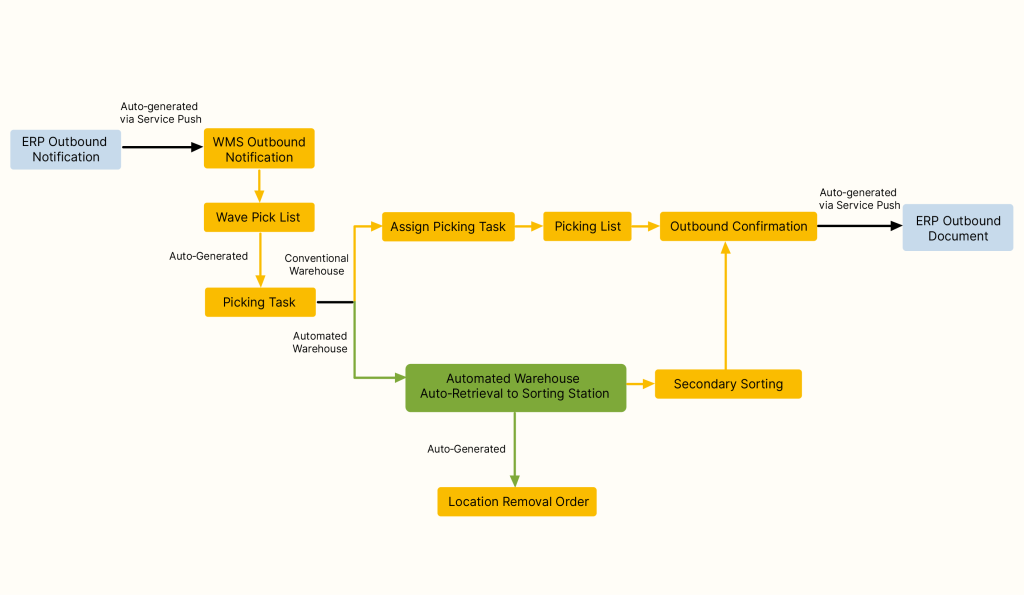
Wave Picking is an outbound method that groups multiple orders or material requirements according to specific rules and processes them together. Orders can be divided into different waves based on factors such as priority, delivery time, warehouse area, or order volume.
Each wave is assigned a specific group of picking tasks, allowing warehouse teams to complete multiple orders within the same picking cycle.
2. Which Industries Use Wave Picking?
- E-commerce: Managing order peaks during promotions and seasonal sales
- Distribution centers: Processing multiple customer orders in organized groups
- Logistics operations: Coordinating orders according to delivery schedules
3. Why Use Wave Picking?
- Improve picking efficiency: Pickers can process multiple orders within one picking cycle, reducing repeated travel.
- Reduce warehouse congestion: Orders from different areas can be scheduled in separate waves to avoid excessive traffic.
- Improve outbound coordination: Picking tasks can be better synchronized with packing, shipping, and delivery schedules.
In addition to outbound strategies, the warehouse storage system also plays an important role in logistics efficiency, inventory accuracy, and long-term operational competitiveness. Choosing the right storage system can directly affect how efficiently your warehouse stores, retrieves, and moves inventory.
Want to find the right warehouse storage system for your operation? Explore our guide to compare different storage systems and identify the solution that best fits your warehouse.
13 Common Warehouse Storage Systems: How to Choose the Best One
Explore 13 popular warehouse storage systems to boost logistics efficiency & inventory accuracy. Learn how to select the ideal storage solution for your warehouse automation needs.
How WMS Optimizes Warehouse Outbound Management
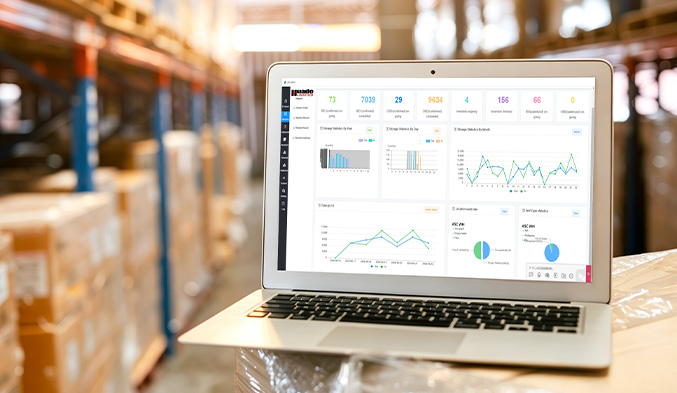
A WMS (Warehouse Management System) can optimize the outbound process from order receiving and inventory allocation to picking, packing, shipping, and inventory tracking. By automating these tasks, WMS helps improve operational efficiency, inventory accuracy, and order fulfillment while reducing manual errors.
1. Automated Order Processing
Traditional warehouses often rely on manual order entry and confirmation, which can be time-consuming and prone to errors. A WMS can automatically receive order information and generate outbound tasks based on predefined rules.
- Automatic order allocation: Assigns inventory and picking tasks based on order priority, inventory availability, and warehouse location.
- Order consolidation or splitting: Combines suitable small orders or divides large orders into manageable tasks.
- Priority management: Processes urgent orders according to predefined fulfillment rules.
2. Multiple Inventory and Outbound Strategies
WMS can support different inventory allocation and outbound rules, helping warehouses manage stock according to product characteristics and operational requirements.
- FIFO: Prioritizes older inventory to reduce the risk of expiration.
- LIFO: Prioritizes recently received inventory where this strategy is appropriate.
- Batch Management: Tracks inventory according to production batches and lot numbers.
- Wave Picking: Groups orders into picking waves to improve outbound efficiency.
- Inventory rotation: Records inventory information such as receiving dates and batch numbers to support appropriate allocation rules.
For products with strict shelf-life requirements, WMS can apply FIFO rules to prioritize older inventory and reduce the risk of expired or slow-moving stock.
3. Intelligent Picking
Picking is one of the most important stages of outbound operations and can also be a major source of manual errors. WMS can automatically assign picking tasks and optimize the sequence based on inventory locations and order requirements.
- Automatic task assignment: Assigns picking tasks according to product locations and order requirements.
- Multiple picking methods: Supports single-order picking, batch picking, and wave picking for different order volumes.
- Barcode scanning: Integrates with PDA devices or handheld scanners to verify products and ensure they match the order.
4. Order Verification, Packing and Shipping
After picking, orders must be verified, packed, and shipped accurately. WMS can connect these processes to reduce errors and improve outbound coordination.
- Automatic verification: Checks picked products against order information and alerts operators when discrepancies occur.
- Packing recommendations: Can recommend suitable packing options based on product dimensions, weight, and order requirements.
- Logistics integration: Connects with transportation or shipping systems to generate shipping information and track order status.
5. Real-Time Inventory Monitoring
WMS continuously updates inventory information as products move through the warehouse, helping keep system inventory records aligned with actual stock levels.
- Real-time inventory updates: Inventory quantities are automatically adjusted after receiving, picking, and shipping operations.
- Low-stock alerts: Predefined inventory thresholds can trigger replenishment notifications.
- Slow-moving inventory analysis: Identifies aging or slow-moving stock so businesses can take appropriate action.
6. Data Analysis for Continuous Optimization
WMS does more than manage daily warehouse operations. It also collects operational data that can help identify bottlenecks and continuously improve outbound performance.
- Order processing analysis: Tracks order processing times and identifies potential operational bottlenecks.
- Picker performance analysis: Provides data to help managers allocate tasks more effectively.
- Picking route optimization: Analyzes high-frequency products and order patterns to optimize inventory locations and reduce unnecessary travel.
Frequently Asked Questions
What is LIFO in warehouse management?
LIFO (Last In, First Out) means the most recently received inventory is picked or shipped first. It is generally suitable for non-perishable goods and certain bulk-material storage applications.
What is the difference between FIFO and LIFO?
FIFO ships the oldest inventory first, while LIFO ships the newest inventory first. FIFO is commonly used for products with expiration dates, while LIFO can suit non-perishable and bulk goods.
Is LIFO suitable for all warehouses?
No. LIFO is not ideal for products with strict shelf-life requirements because older inventory may remain in storage longer. The appropriate strategy depends on product characteristics and warehouse operations.
What is Batch Management in a warehouse?
Batch Management tracks and manages inventory according to production batches or lot numbers. It is especially important for pharmaceuticals, food, and chemicals where traceability is required.
What is Wave Picking?
Wave Picking groups multiple orders into scheduled picking waves based on factors such as priority, delivery time, or warehouse location. It can help improve picking efficiency and reduce warehouse congestion.
How does WMS support FIFO and LIFO?
A WMS (Warehouse Management System) can record inventory information and apply predefined allocation rules, such as FIFO or LIFO, when assigning inventory for outbound orders.
Can WMS combine different outbound strategies?
Yes. A WMS can support different rules for different products or orders. For example, a warehouse may use FIFO for food products, LIFO for certain bulk materials, and wave picking for high-volume orders.
How do I choose the right warehouse outbound strategy?
Consider product shelf life, SKU variety, order volume, storage layout, handling requirements, and traceability needs. WMS capabilities should also be considered when selecting and implementing an outbound strategy.