
Table of Contents
Contact Us
Recent Posts
Follow Us
Introduction
A pallet shuttle system is one of the most effective warehouse storage ideas for businesses looking to maximize warehouse pallet storage while reducing labor and forklift travel. By combining intelligent shuttle vehicles with a high-density pallet shuttle racking system, it delivers an ideal balance of storage density, efficiency, and investment cost.
As demand for faster, safer, and more automated logistics continues to grow, traditional pallet racking often struggles to meet the needs of bulk storage. Today, pallet shuttle systems are widely used as automated warehouse storage systems in food, beverage, cold storage, pharmaceuticals, chemicals, and other industries that require high-density pallet storage.
Is a Pallet Shuttle System Right for Your Warehouse?
A pallet shuttle system is best suited for warehouses that prioritize high-density pallet storage and operational efficiency. Use the checklist below to quickly evaluate whether it’s the right solution for your facility.
- Your pallets are standardized in size and weight.
- You store large volumes of the same SKU.
- You require cold storage compatibility or improved forklift safety.
- Your warehouse layout supports long, high-density storage lanes.
If you meet three or more of these conditions, a pallet shuttle racking system is likely a cost-effective solution for your warehouse.
What Is a Pallet Shuttle System?
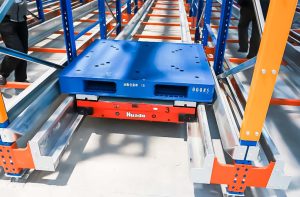
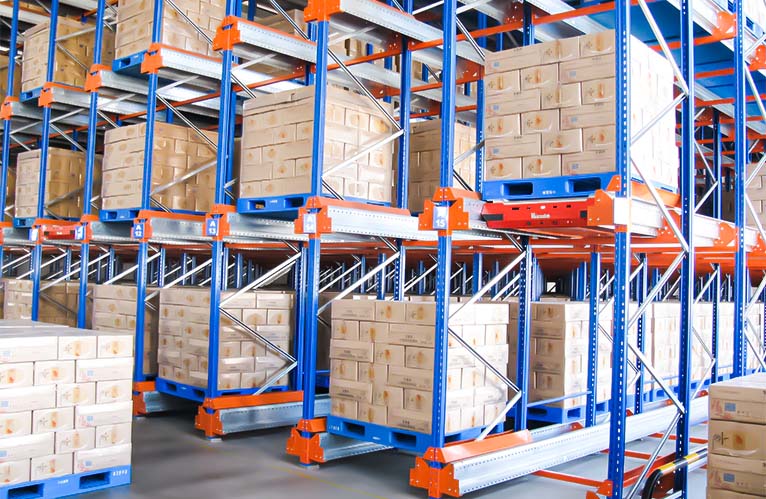
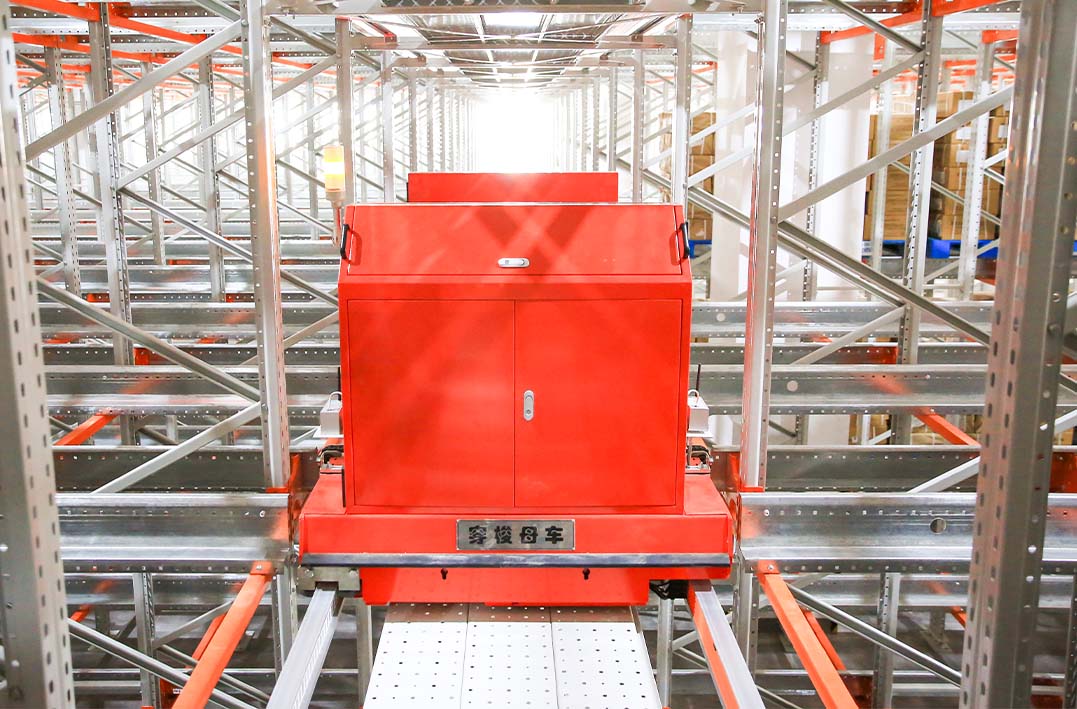
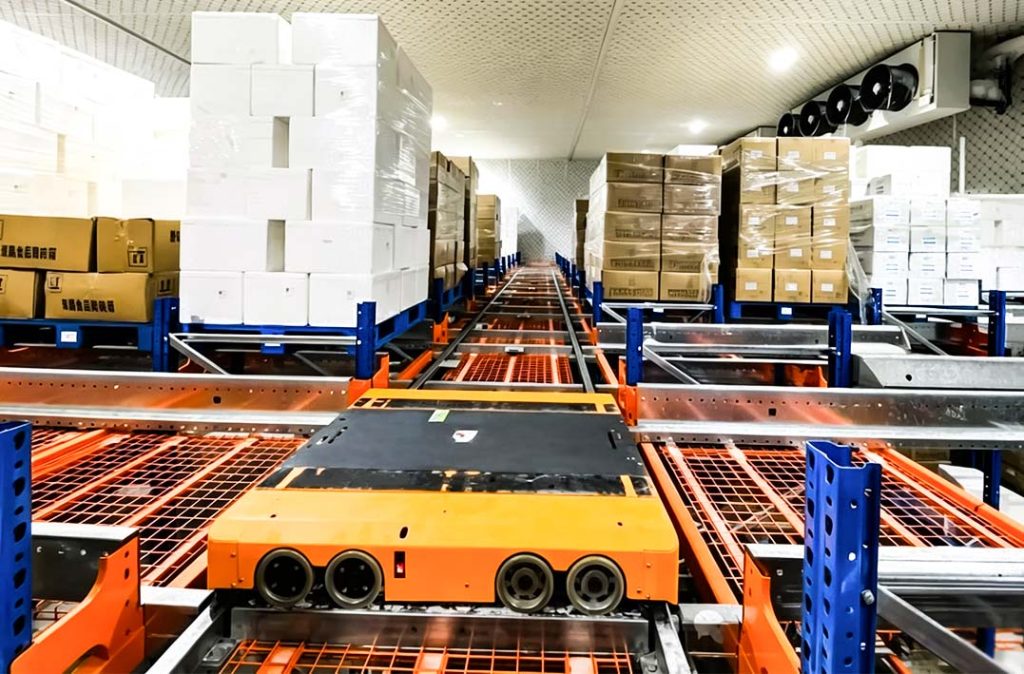
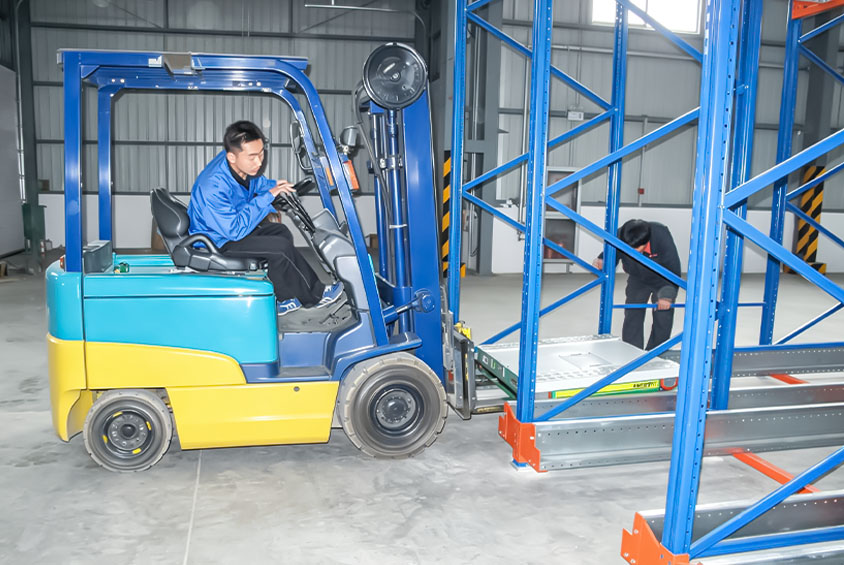
A pallet shuttle system, also known as a radio shuttle racking system, is a semi-automated high-density storage solution designed for efficient pallet handling. It combines heavy-duty pallet racking, shuttle vehicles, rails, and a control system to automate pallet storage and retrieval within each lane. Forklifts remain at the aisle entrance while the radio shuttle transports pallets inside the racking, improving safety, storage density, and operational efficiency.
1. How Does a Pallet Shuttle System Work?
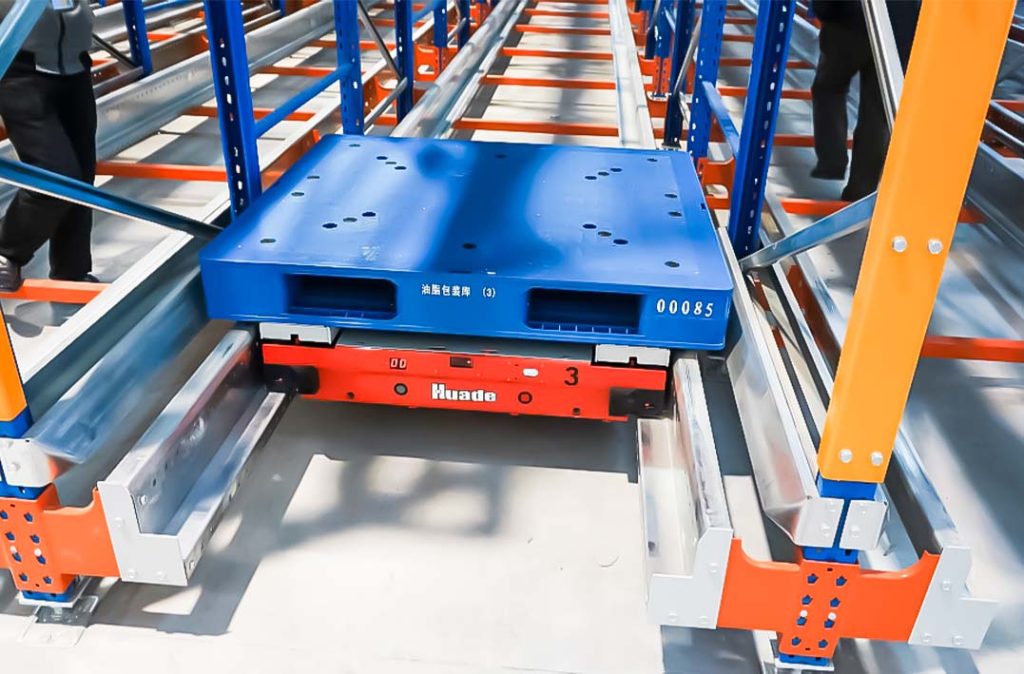
Guide rails are installed inside each storage lane to allow the radio shuttle to move pallets automatically. Once a forklift places a pallet at the aisle entrance, the shuttle transports it to the assigned storage location. During retrieval, it returns the required pallet to the front of the lane, while forklifts remain outside the racking throughout the entire process.
Depending on operational requirements, pallet shuttle systems are available in three configurations:
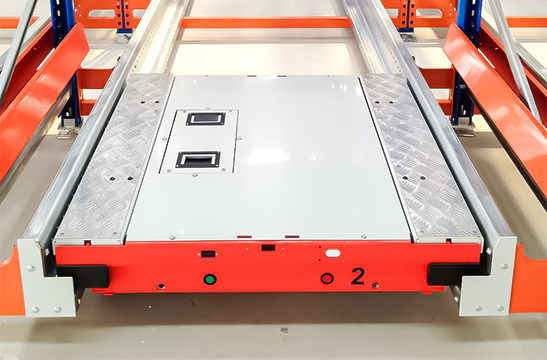
Operates within one lane and typically supports LIFO (Last In, First Out) inventory management, making it ideal for deep-lane storage and bulk inventory.
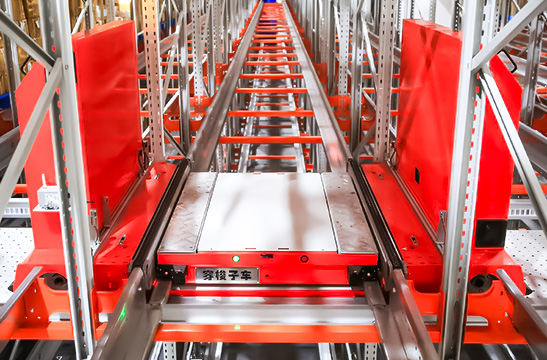
Allows pallet access from both ends of the lane, providing greater operational flexibility and supporting both FIFO and LIFO layouts.
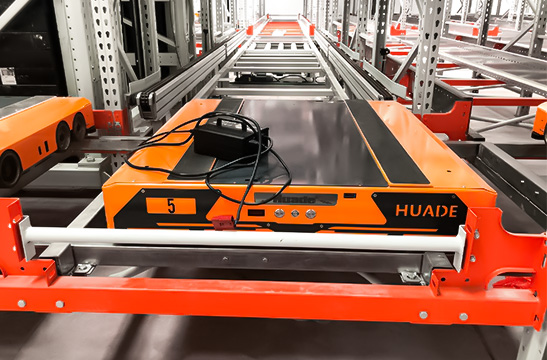
Moves in four directions and can transfer between levels using a lift, enabling fully automated, multi-aisle warehouse operations for complex storage requirements.
By separating forklift operations from pallet movement inside the racking, the system improves safety, reduces equipment damage, and delivers more efficient pallet handling.
2. Key Benefits of a Pallet Shuttle Racking System
Maximize Storage Capacity
High-density lane storage can increase warehouse space utilization to over 80%, significantly reducing the need for additional floor space and lowering building costs.
Improve Warehouse Safety
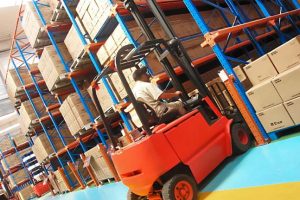
Forklifts remain outside the storage lanes, minimizing rack damage, product loss, and collision risks.
Increase Throughput
Automated pallet movement ensures consistent handling speed and higher productivity than traditional drive-in racking systems.
Ideal for Cold Storage
The system can be customized for low-temperature environments with cold-resistant, waterproof, and explosion-proof configurations, making it an excellent choice for cold chain logistics.
Cost-Effective Automation
Compared with a fully automated AS/RS, a pallet shuttle system offers a lower initial investment while still delivering substantial improvements in storage efficiency and labor productivity. Many warehouses achieve a return on investment within 2–5 years, depending on operating conditions.
Support FIFO or LIFO Inventory Management
The system can be configured for either FIFO (First In, First Out) or LIFO (Last In, First Out) to meet different inventory rotation and batch management requirements.
3. Main Components of a Pallet Shuttle System
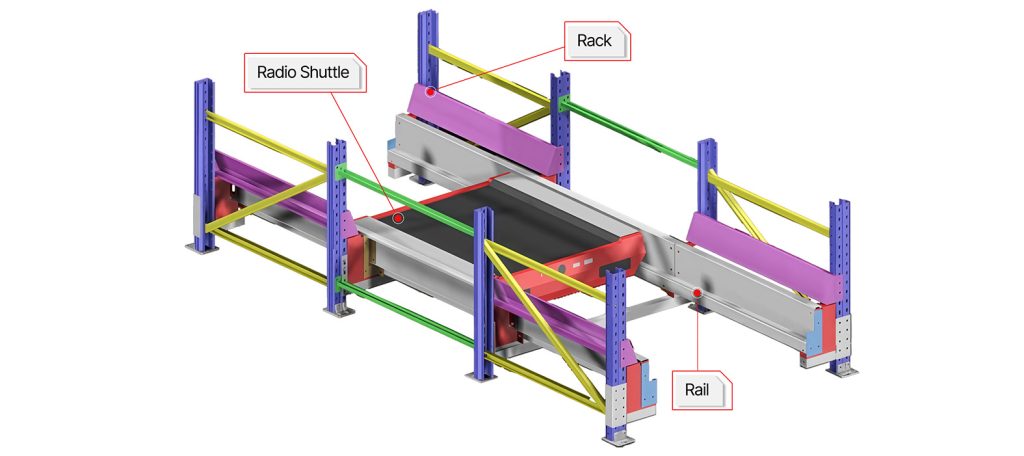
A standard pallet shuttle racking system typically includes:
- Heavy-duty pallet racking (uprights, beams, rail beams, bracing, and rack protection)
- Guide rails for shuttle travel
- Battery-powered intelligent radio shuttle
- Remote controller, positioning sensors, and control system
- Safety stops, end protectors, and braking devices
- Optional equipment, including pallet lifts, transfer systems, and WMS/WCS integration
A typical storage lane accommodates 4–10 pallet positions, while longer lanes can be custom-designed to match the warehouse layout and storage capacity requirements.
4. Typical Applications
A pallet shuttle system is best suited for warehouses handling standardized pallets, a limited number of SKUs, and high inventory volumes. Typical applications include:
- Food and beverage warehouses
- Cold storage and cold chain distribution centers
- Pharmaceutical, chemical, and FMCG warehouses
- Tobacco, grain, furniture, and building materials storage
- E-commerce bulk storage areas, raw material warehouses, and finished goods warehouses
Drive-In Rack vs. Pallet Shuttle System: Which Is the Better Choice?
When evaluating automated warehouse storage systems, many businesses compare Drive-In pallet racking with a pallet shuttle system. While both are designed for high-density pallet storage, they differ significantly in efficiency, safety, automation, and long-term operating costs.
| Feature | Drive-In Pallet Racking | Pallet Shuttle System |
|---|---|---|
|
Operating Method |
Forklifts drive into storage lanes to load and retrieve pallets. |
A radio shuttle automatically transports pallets, while forklifts remain outside the racking. |
|
Storage Density |
High (around 70%) |
Very High (up to 80%+) |
|
Safety |
Higher risk of rack damage from forklift impacts. |
Improved safety by separating forklifts from storage lanes. |
|
Handling Efficiency |
Depends heavily on forklift operators. |
Consistent and faster pallet handling through shuttle automation. |
|
Cold Storage Suitability |
Limited due to forklift operation in low temperatures. |
Excellent, with optional low-temperature configurations. |
|
Maintenance Costs |
Higher due to frequent rack repairs. |
Lower rack maintenance and reduced equipment damage. |
|
Initial Investment |
Lower |
Moderate, with better long-term return on investment. |
Which One Should You Choose?
Choose a pallet shuttle racking system if your warehouse requires higher storage density, improved safety, stable throughput, or reliable operation in cold storage environments. Although the initial investment is higher than a Drive-In rack, the lower operating costs and greater efficiency often provide a better long-term return.
If your warehouse has a limited budget, lower throughput requirements, or is intended for temporary bulk storage, Drive-In pallet racking can still be a practical and cost-effective solution.
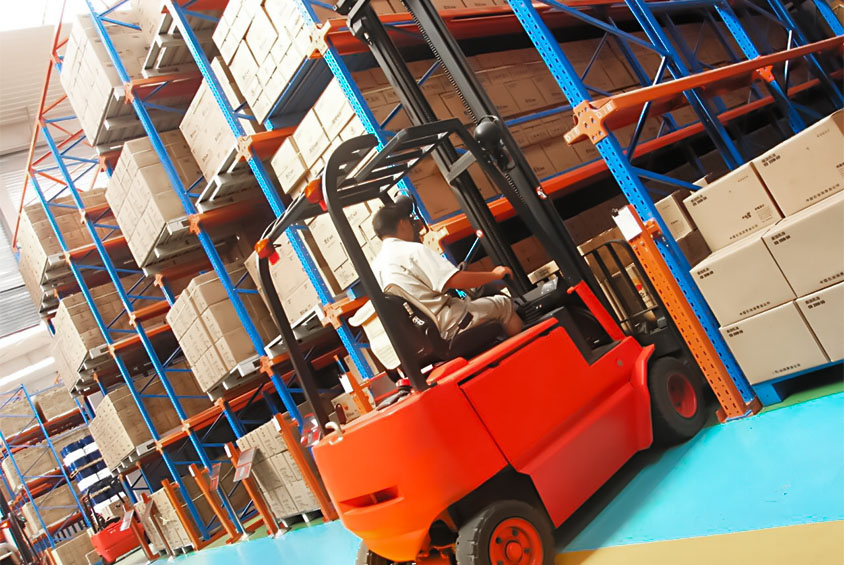
Choosing between a drive-in pallet racking system and a pallet shuttle system depends on your storage density requirements, operational goals, and budget. If you want to learn more about how drive-in racking works, its advantages, limitations, and pricing factors, check out our detailed guide:
Drive In Pallet Racking: Complete Guide, System Comparisons & Prices
This complete guide answers those questions by explaining how drive in pallet racking works, where it performs best, how it compares with other high-density storage systems, and what you should know before investing.
Radio Shuttle vs. Mother-Child Shuttle vs. Four Way Pallet Shuttle
After deciding to implement a pallet shuttle system, the next step is choosing the right shuttle technology. From a cost-effective radio shuttle to a fully automated four way pallet shuttle, each solution is designed for different warehouse layouts, throughput requirements, and automation levels.
| Radio Shuttle | Mother-Child Shuttle | Four Way Pallet Shuttle |
|---|---|---|
|
Movement:
Moves within a single storage lane. |
Movement:
The mother shuttle transfers the child shuttle between multiple storage lanes. |
Movement:
Moves in four directions and can change levels with a lift. |
|
Best For
Bulk storage with fewer SKUs and large pallet quantities. |
Best For
Large warehouses with multiple aisles and high throughput requirements. |
Best For
Multi-SKU warehouses, irregular layouts, and highly automated operations. |
|
Flexibility:
Low flexibility for fixed-lane storage. |
Flexibility:
Medium flexibility with multi-lane operation. |
Flexibility:
Excellent flexibility with multi-directional movement. |
|
Automation Level:
Semi-automated operation. |
Automation Level:
Highly automated shuttle coordination. |
Automation Level:
Fully automated intelligent storage solution. |
|
System Complexity:
Low complexity and easy operation. |
System Complexity:
Medium complexity with mother-child coordination. |
System Complexity:
High complexity requiring advanced control systems. |
|
Investment:
Low initial investment. |
Investment:
Medium investment for larger warehouse projects. |
Investment:
Higher investment with greater flexibility and scalability. |
Selection Recommendations:
- Choose a Radio Shuttle: if your warehouse stores large quantities of standardized pallets with relatively few SKUs and requires an affordable, high-density storage solution.
- Choose a Mother-Child Shuttle: if you need to move shuttle vehicles efficiently between multiple storage lanes in a large warehouse.
- Choose a Four Way Pallet Shuttle: if your warehouse has an irregular layout, frequent SKU changes, multiple inbound and outbound stations, or plans for future automation and flexible expansion.
How to Choose the Right Pallet Shuttle System
Choosing the right pallet shuttle system is not about selecting the most advanced technology—it’s about finding the solution that best matches your warehouse operations, storage requirements, and future growth plans. Evaluate the following six factors before making your investment.
1. Evaluate Your Throughput Requirements
Warehouse throughput is one of the most important factors when selecting a pallet shuttle system. Estimate how many pallets need to be stored and retrieved each day or hour.
- Low throughput– A standard radio shuttle with one or two shuttle vehicles is usually sufficient for daily operations.
- High throughput – Multiple shuttle vehicles or a four way pallet shuttle can significantly improve efficiency by reducing travel time and balancing workloads across different storage lanes.
2. Decide Between FIFO and LIFO
Your inventory rotation strategy directly affects the racking layout.
- FIFO (First In, First Out) is recommended for food, beverage, pharmaceutical, and other products with expiration dates.
- LIFO (Last In, First Out) is often preferred for chemicals, raw materials, and bulk storage where maximizing storage density is the priority.
3. Check Your Pallets and Product Characteristics
Before designing a pallet shuttle racking system, consider the physical characteristics of your pallets and products.
- Pallet dimensions – Standard and non-standard pallets require different shuttle lifting mechanisms and rack configurations.
- Load capacity – Heavy loads require stronger motors, wheels, and structural components. HUAYIDE’s four way pallet shuttle can be customized to handle loads of up to 2.5 tons for heavy-duty applications.
- Pallet quality – Damaged or flexible pallet bottoms may require customized shuttle designs or guide rail configurations to ensure stable lifting and transportation.
4. Assess Your Warehouse Conditions
The building itself plays an important role in determining the most suitable solution.
- Building height – Warehouses over 12 meters typically benefit from automated warehouse storage systems integrated with pallet lifts or stacker cranes.
- Floor flatness – A radio shuttle racking system requires accurate rail alignment. Uneven floors can affect shuttle performance and reliability.
- Building layout – Warehouses with irregular columns, multiple fire zones, or complex layouts are often better suited to a four way pallet shuttle system.
5. Plan for Future Expansion
Choose a solution that can grow with your business.
- If your SKU count is expected to increase, consider a Mother-Child Shuttle or Four Way Pallet Shuttle for greater flexibility.
- If you plan to integrate with an existing WMS, choose an open WCS platform that supports future software upgrades and third-party integration.
6. Choose the Right Supplier
Selecting a reliable automated pallet racking system company is just as important as choosing the equipment itself.
When evaluating suppliers, consider:
- Proven experience in your industry, especially for cold storage or specialized applications.
- Successful project references and real customer case studies.
- Equipment testing capabilities, including battery performance and low-temperature testing.
- Comprehensive after-sales service, spare parts support, and software upgrades.
Why Choose HUAYIDE?
HUAYIDE provides complete automated warehouse racking system services, from warehouse planning and 3D simulation to manufacturing, installation, commissioning, and lifetime technical support.
Every shuttle vehicle is fully tested before delivery, including load testing on real racking systems. For cold storage projects, dedicated battery and low-temperature testing ensure reliable performance in demanding environments.
In addition to a standard warranty, HUAYIDE offers lifetime technical support and free lifetime software upgrades, helping customers maximize the long-term value of their warehouse automation investment.
Conclusion
A pallet shuttle system is one of the most practical and cost-effective automated warehouse storage systems for businesses seeking higher storage density, improved safety, and greater operational efficiency. Whether you choose a radio shuttle racking system or a fully automated four way pallet shuttle, the right solution depends on your pallet specifications, throughput requirements, warehouse layout, and long-term growth plans.
Before making a decision, review your SKU profile, pallet dimensions, inventory turnover, and warehouse conditions. A well-designed pallet shuttle racking system not only maximizes warehouse pallet storage but also reduces operating costs and creates a safer, more efficient warehouse.
If you’re planning a new warehouse or upgrading an existing facility, HUAYIDE can help you evaluate the best solution for your operation. Our engineering team provides customized warehouse design, free 3D layout simulations, equipment testing, and complete automated warehouse racking system services to ensure your investment delivers long-term value.
Ready to Upgrade Your Warehouse?
Whether you’re considering a radio shuttle, a four way pallet shuttle, or a complete automated warehouse storage system, HUAYIDE’s experts can help you find the most efficient solution for your business.
Contact us today for a free warehouse consultation and customized 3D layout design.
Frequently Asked Questions
What is a pallet shuttle system?
A pallet shuttle system is a semi-automated high-density storage solution that uses a shuttle vehicle to transport pallets within storage lanes. It reduces forklift travel, increases storage capacity, and improves warehouse safety, making it a popular choice for modern automated warehouse storage systems.
What is the difference between a radio shuttle and a four way pallet shuttle?
A radio shuttle operates within a single storage lane and is ideal for high-density storage of large pallet volumes. A four way pallet shuttle can move in four directions, transfer between aisles and levels, and is better suited for highly automated warehouses with multiple SKUs and complex layouts.
Can a pallet shuttle system support FIFO and LIFO inventory management?
Yes. A pallet shuttle racking system can be configured for either FIFO (First In, First Out) or LIFO (Last In, First Out), depending on the warehouse layout and inventory requirements. This flexibility makes it suitable for industries such as food, pharmaceuticals, chemicals, and manufacturing.
Is a pallet shuttle system suitable for cold storage warehouses?
Yes. Pallet shuttle systems are widely used in cold storage and cold chain logistics. They can be equipped with low-temperature batteries, waterproof electrical components, and cold-resistant materials to ensure reliable performance in sub-zero environments.
How much storage capacity can a pallet shuttle system increase?
Compared with conventional pallet racking, a pallet shuttle system can increase warehouse space utilization to over 80% by minimizing forklift aisles and maximizing deep-lane storage. The actual capacity improvement depends on the warehouse layout, pallet dimensions, and storage strategy.
Why Choose HUAYIDE as Your Pallet Shuttle System Supplier?
HUAYIDE provides customized pallet shuttle system solutions for different warehouse requirements, including system design, manufacturing, installation, and technical support.
With extensive project experience, professional engineering capabilities, and advanced testing facilities, HUAYIDE helps customers build reliable pallet shuttle racking systems for food, beverage, cold storage, manufacturing, and other industries.
From free 3D warehouse simulations to lifetime technical support, HUAYIDE is committed to delivering efficient and long-lasting automated warehouse storage systems.